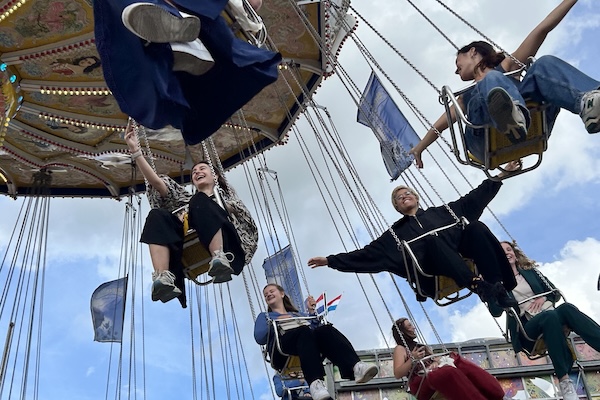
 Schueberfouer 2025;
Credit: Elza Osmane, Chronicle.lu
Schueberfouer 2025;
Credit: Elza Osmane, Chronicle.lu
Dating back to 1340, the Schueberfouer has evolved over nearly seven centuries from a regional trading fair into one of Luxembourg's most recognisable annual traditions.
The 2026 edition officially opens on Friday 21 August at the Champ du Glacis and runs for 20 days until Wednesday 9 September. It brings together 214 fairground establishments, including eight new attractions.
Today, the Schueberfouer is considered the largest annual funfair in Luxembourg and the Greater Region, alongside other major regional funfairs in France, such as the Foire Attractive de Nancy and the Foire de Mai in Metz.
The beginnings of Schueberfouer, however, were quite different. It was originally established as a commercial market, attracting merchants from surrounding territories to sell goods ranging from cloth and household products to livestock. Its timing around St Bartholomew's Day also coincided with the traditional harvest period.
It all began with John the Blind
The fair was established by John the Blind, King of Bohemia and Count of Luxembourg, through a charter issued on 20 October 1340. The aim was to strengthen Luxembourg City's role as a trading centre along important European commercial routes.
Originally held on the Plateau du Saint-Esprit in Luxembourg-Ville, the market lasted eight days. As it expanded, it moved to Limpertsberg in 1610 and eventually to the Champ du Glacis in 1893, where it still remains nowadays.
Schueberfouer through the ages
Entertainment gradually became more important alongside commerce, with concerts, dancing and games appearing during the eighteenth century and mechanical rides arriving in the nineteenth century. By the 20th century, the Schueberfouer was increasingly developing into the funfair recognised today.
Earlier this year, Chronicle.lu spoke with historian Véronique Faber, whose doctoral research examined Schueberfouer's development, particularly during the 1960s. She highlighted how new technologies, changing consumer habits and the growing purchasing power of young people helped transform the fair, with bumper cars, rock 'n' roll and increasingly sophisticated rides becoming part of its identity.
The Schueberfouer has also faced interruptions during major historical events, namely both World Wars and, most recently, in 2020 and 2021 due to the COVID-19.
From medieval market to modern funfair
The scale of the Schueberfouer has grown since its early days. The original eight-day market now runs for twenty days, while its focus has shifted from trade and livestock towards amusement rides, games, gastronomy and entertainment.
The VdL estimates that the Schueberfouer records around 1.5 million to two million visits each year, more than twice Luxembourg's resident population. The event is also an important source of income for many travelling fairground businesses.
Despite its growth, the fair has retained its core traditions, such as the sheep procession and “Hämmelsmarsch”, which recall its links to livestock trading and agriculture, while “Ham a Kuch” (ham and cake) remains part of the traditional opening ceremony.
The importance of these traditions was formally recognised in 2008, when the Schueberfouer and its “Hämmelsmarsch” were added to Luxembourg's national inventory of intangible cultural heritage. They were among the first traditions included in the inventory.
Unlike the prolonged dry and sunny conditions experienced in Luxembourg this summer, the opening of this year's fair is set to bring some rain. MeteoLux has forecast showers and thunderstorms for Friday afternoon and evening, with further light showers possible on Saturday 22 August, before drier conditions return on Sunday 23 and Monday 24 August.