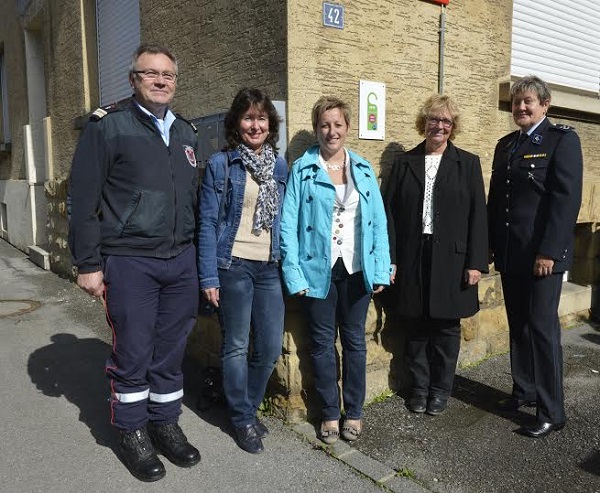
The Collège des bourgmestre et échevins and the Grand Ducal Police today presented the results of the label evaluating the quality of furnished rooms.
The label was first introduced in December 2012 as a means of creating better room comfort and encouraging landlords and owners to perform changes and renovations to their buildings.
Distributed in buildings controlled for a period of two years, the four-point label certified on one hand the compliance of rooms and on the other the degree of comfort, evaluated by construction, cleanliness, equipment and building management.
According to the presented report, seven buildings have been certified since the delivery of the first label in March 2013, of which two have already benefitted from an extension of the expiry date.
Since last calling on owners and operators to regularise their furnished rooms in 2013, the 'furnished rooms' Commission received 29 new statement from buildings operating as collective housing. The Ville de Luxembourg also reported a notable improvement in cooperation from owners, who often take the initiative to contact the various departments of the communal administration in order to gain more information on compliance criteria regarding the modified Grand Ducal Regulation of 25 February 1979.
A special stamp was also created, deeming a building as in compliance with development and security plans for collective housing as outline by the Service Logement and the Service Incendie et Ambulance. This stamp allowed the Department of Planning to validate plans more quickly.
Since the 'furnished rooms' committee was created, 98 buildings and 279 furnished rooms have been inspected. The Committee reported that the problem often arises during the checks that when rooms are found to not be in compliance with regulations, the building owners eschew responsibility so that the changes are made payable by the operator, in the event that the latter is able to bear the costs.
The committee advised that to avoid closure to furnished rooms or entire buildings, each stakeholder needed to collaborate towards the costs.
The Ville de Luxembourg stated that it would continue to collaborate with the Service Régional de polices spéciales to continually raise awareness among operators and owners, by providing them with leaflets and performing regular checks.
Photo by Ville de Luxembourg/ Charles Soubry