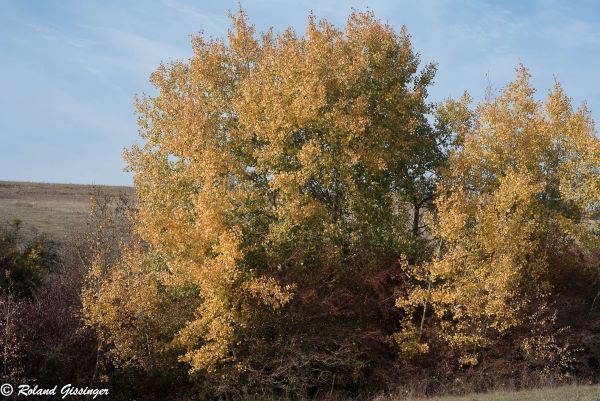
 Trembling aspen;
Credit: Roland Gissinger
Trembling aspen;
Credit: Roland Gissinger
On Tuesday 20 January 2026, the Hëllef fir d’Natur Foundation announced its chosen “tree of the year”, selecting the trembling aspen (Populus tremula) to highlight its ecological value in Luxembourg.
Description and characteristics
The aspen is a deciduous tree from the willow family (Salicaceae). It usually reaches a height of fifteen to 25 metres and has a slender, often translucent crown. The trembling aspen can reach an age of 100 years and a trunk diameter of 1 metre. Its rounded to heart-shaped leaves with a long, laterally flattened petiole stand out in particular. They begin to tremble even with a slight breeze, which explains the tree’s name. The bark remains smooth and grey-green when the tree is young, then darkens and develops fine cracks over time. In spring, inconspicuous catkin-shaped flowers appear even before the leaves emerge.
Distribution and adaptability
The trembling aspen grows across large parts of Europe, as well as in northern and central Asia. It grows both in lowlands and at higher altitudes and shows “remarkable” adaptability. As a typical pioneer species, it quickly colonises open areas such as clear-cut sites, burned areas or embankments. It places few demands on soil conditions and grows both on nutrient-poor soils and on fresh, well-aerated sites.
With its extensive root system, the species plays a key role in soil stabilisation and forest recovery. The Hëllef fir d’Natur Foundation identified this characteristic as one of the main reasons to plant the tree as part of its reforestation work. In 2024, the foundation planted 275 aspens, followed by 625 in 2025, and it will plant additional aspens in mixed deciduous forests in 2026.
Use and landscape importance
The organisation noted that the trembling aspen has limited economic importance, but people use it in several ways. Its light and soft wood suits the production of particle boards, paper, sauna construction and parquet flooring. The leaves and bark contain salicylic acid compounds that reportedly offer analgesic, anti-inflammatory and fever-reducing properties.
In landscape design, planners value the tree for its rapid growth and delicate appearance, particularly in natural parks, along forest edges and within reforestation projects. The species also supports the restoration of degraded areas and contributes to landscape diversity.
An essential tree for biodiversity
The organisation stated that the trembling aspen plays a major role in biodiversity, ranking among the main food plants for native butterflies, as well as for numerous insect species, beetles and wild bees. Many bird species use the tree for nesting and feeding. Older or dead specimens also provide cavities and deadwood structures upon which bats, woodpeckers and fungi rely. As a pioneer species, the trembling aspen supports the development of diverse forest communities and contributes to ecological balance.