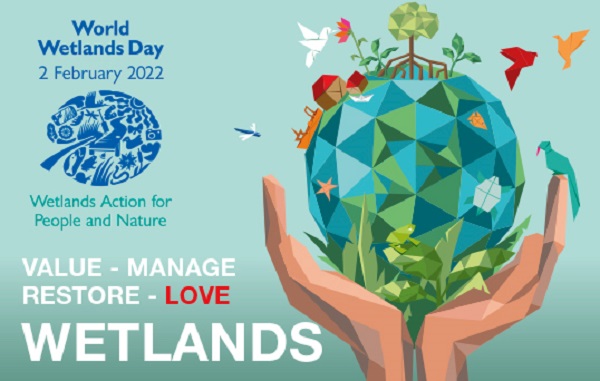
Wednesday 2 February marks World Wetlands Day 2022; on this special occasion, the Upper Sûre Nature Park (Naturpark Öewersauer) in Luxembourg has invited members of the public to discover this region, as well as to learn more about the origins of this day and the two man-made wetlands in the Grand Duchy.
On 2 February 1971, in the Iranian city of Ramsar, several parties signed the Ramsar Convention on Wetlands of International Importance Especially as Waterflow Habitat, an international treaty aimed at maintaining wetlands worldwide. This is the oldest international nature conservation treaty.
Since then, no fewer than 2,435 wetlands (a total of 254,685,425 hectares) in 172 states have been declared “Ramsar sites”. The term "wetland" groups together all living environments related to water, such as springs, streams, wet meadows, swamps and lakes. In 1971, attention was focused on the importance of wetlands as a breeding and resting place for birds. The Upper Sûre Nature Park stressed, however, that wetlands are extraordinary habitats not only for birds.
Luxembourg ratified the Ramsar Convention in 1998 and today the country has two areas of global importance: “Haff Réimech” (313 hectares) and “Vallée de la Haute-Sûre” (one of the few cross-border areas with 16,900 hectares in Luxembourg and 29,000 hectares in Belgium).
While there are many natural Ramsar sites internationally, the two recognised areas in Luxembourg are the result of human activity: the Haff Réimech nature reserve in Remerschen is a former gravel pit and Upper Sûre Lake was created, among other things, for the supply of drinking water. With the dam lake, the natural course of the Sûre River was interrupted. Whilst this had disastrous consequences for many animal species, the Upper Sûre Nature Park stressed the importance of recognising today the added value of this area for many animal and plant species, as well as for humans.
Nevertheless, many wetlands are currently in poor condition or have already disappeared. Globally, the number of wetlands has declined by around 50% (80% in Luxembourg). The nature park noted that the need for profitability in the agricultural sector is not only a cause of loss of land, but also increases the risk of water pollution by nitrates and pesticides. Rapid population growth leads to increased fragmentation of the landscape and requires permanent adaptation of wastewater treatment infrastructure. Moreover, the pressure on bathing waters from leisure activities has reached a barely manageable level in recent years.
The nature park argued that, apart from the quality of the water (the Upper Sûre Lake is the largest drinking water reserve in Luxembourg), the multiple living environments such as streams, wet meadows and swamps must be preserved in the catchment area. With this in mind, the majority of the natural living environments in the Upper Sûre region have been declared a national nature reserve (in 2014) or a Natura 2000 zone (in 2018), which emphasises the value of nature protection and makes it possible to envisage extensive protection measures.
On the occasion of World Wetlands Day 2022, the Upper Sûre Nature Park is encouraging everyone to come and see these areas for themselves and to visit the region around the reservoir. Whilst the nature park is unable to organise its traditional guided hikes and workshops this year, due to the COVID-19 pandemic, its employees are offering two hiking circuits that will allow visitors to explore the wetlands along the Upper Sûre and the Béiwenerbaach (two lakes along the Sûre River).