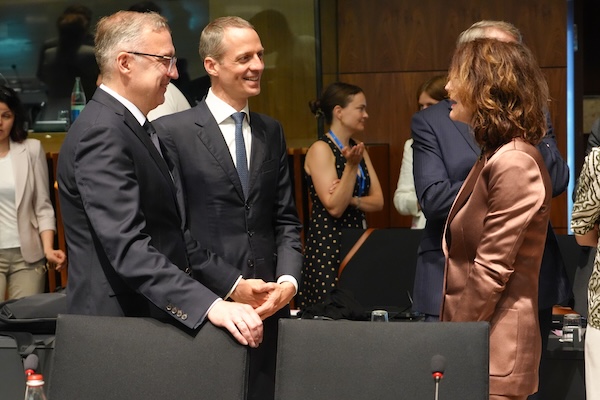
 (L-R) Andres Sutt, Minister of Energy and the Environment of Estonia; Serge Wilmes, Luxembourg's Minister for the Environment, Climate and Biodiversity;
Credit: Luxembourg’s Ministry for the Environment, Climate and Biodiversity
(L-R) Andres Sutt, Minister of Energy and the Environment of Estonia; Serge Wilmes, Luxembourg's Minister for the Environment, Climate and Biodiversity;
Credit: Luxembourg’s Ministry for the Environment, Climate and Biodiversity
On Thursday 25 June 2026, Luxembourg’s Minister for the Environment, Climate and Biodiversity, Serge Wilmes, participated in the meeting of the European Union (EU) "Environment" Council in Luxembourg to discuss revision of CO₂ emission standards for cars and vans, the link between nature, businesses and competitiveness, water resilience, the REACH Regulation, as well as resilience to climate change.
According to Luxembourg’s Ministry for the Environment, on the sidelines of the Council, Minister Wilmes also held several bilateral meetings with his counterparts and their respective delegations.
Minister Wilmes during the discussions recalled that the transition to zero-emission mobility must be fully aligned with the EU's climate objectives. He also underlined that the geopolitical context, energy markets and developments in sales confirm the need to maintain an ambitious, clear and predictable electrification pathway, guaranteeing legal certainty and the attractiveness of investments, said the ministry.
The ministers then held an exchange on the impact and dependence of businesses on biodiversity, highlighting that on average, 48.9% of countries' economic production is highly dependent on nature.
Minister Wilmes underlined the urgency of addressing the triple planetary crisis, stressing that preserving natural capital is essential for sustainable prosperity. He called for a comprehensive approach that recognises both the economic and intrinsic value of ecosystems, tackles their degradation through structural measures and ensures strict regulation of emerging instruments such as nature credits.
Speaking on the LIFE Programme, Minister Wilmes described it as an essential tool that has delivered tangible environmental results for more than 30 years, particularly for smaller Member States, through knowledge sharing, networking and the exchange of best practices. He reaffirmed Luxembourg's commitment to maintaining the programme in the future.
On the strategy for water resilience, Minister Wilmes underlined that this momentum is also reflected at national level, with the preparation of a dedicated strategy currently underway.
The ministry stated that while water demand remains broadly stable, Luxembourg warned of growing pressure on water resources by 2040. Minister Wilmes highlighted the need for awareness campaigns, incentives, digital tools and greater EU support to mobilise private investment.
On the REACH Regulation, Minister Wilmes expressed regret over the European Commission's decision to drop its planned revision, while stressing the need to modernise the framework and maintain high standards for health, environmental protection and innovation.
Regarding the future Circular Economy Act, the ministry said that Luxembourg joined Belgium and the Netherlands in calling for an ambitious and coordinated approach, highlighting the importance of the polluter-pays principle, waste prevention and product repairability.
During discussions on climate resilience, Minister Wilmes emphasised the need for clear and predictable policies, strategic public funding to attract private investment and a transition that strengthens competitiveness, employment and energy security.