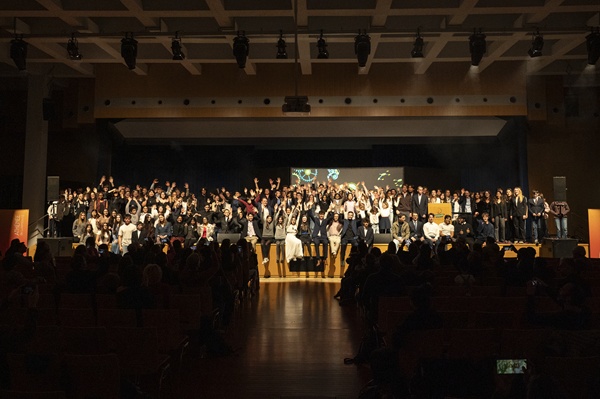
 National Jonk Fuerscher Contest 2026;
Credit: Victor Beusch/FJSL
National Jonk Fuerscher Contest 2026;
Credit: Victor Beusch/FJSL
The 55th edition of the National Jonk Fuerscher Contest took place on Friday 13 and Saturday 14 March 2026, bringing together more than 160 students who presented a record 96 projects, according to the Fondation Jeunes Scientifiques Luxembourg (FJSL).
Participants aged eleven to 21, representing around 45 nationalities, took part in the competition, which encourages young people in Luxembourg to explore scientific research and develop their passion for science, technology, engineering and mathematics (STEM). Notably, this year's edition saw more female than male participants.
Over the two days, participants presented their work to a jury composed of scientists and representatives from Luxembourg's research and industry sectors at the Forum Geesseknäppchen. They also showcased their projects to visiting school groups, classmates and other guests during an open doors event. While the young researchers shared their work with the public, the jury evaluated the projects and deliberated on the awards.
The event concluded with an awards ceremony on Saturday evening, during which every participant received a prize in recognition of their work and dedication.
Several top projects were selected to participate in international competitions, including:
- EU Contest for Young Scientists (EUCYS): Alexandra Antunes Martins and Polly Fernandez - "Spectrophotometric Determination of Nitrate in River Water and an Evaluation of Potential Health Risks"; Leyla Donmez, Mira Karol and Candice Boutoleau - "Correlation between the popularity of songs and their proximity to Euclidean rhythm"; Rodion Zaichikov - "Expanding low-cost hypersonic wind tunnel with arc jet capabilities"
- GeniUS Olympiad (New York): Kiara Bromfield and Raluca Lacob - "Effect of water pollution on algae growth"
- China Adolescents Science and Technology Innovation Contest (CASTIC): Maxim Lebedev - "Adaptive Urban Traffic Analysis: A Simulation of traffic congestion within and around Luxembourg City"
- Taiwan International Science Fair (TISF): Boyana Ivanova - "Hera Health; William Duraku - BeeInformed: A Reliable AI Powered Hive Monitoring System against Asian Hornet Predation"
- International Science and Engineering Fair (ISEF; Phoenix, Arizona): Harald Sveen - "The geometry of gravity: joint bayesian Inference of milky way dark matter halo flattening using GD–1 and rotation curve data"
- Grand Contest on Chemistry for High School Students (Gracon; Japan): Can Sayinatac - "How does pH modulate the fluorescence quenching response of nitrogen-doped carbon quantum dots to Cu²⁺ and Pb²⁺"
This edition also marked the launch of a new science and art competition for primary school age children, the Pépinière drawing contest. The winners were:
- Best drawing – Engineering & Technology: Platon Lapko
- Best drawing – Physics, Chemistry & Environment: Astrid Perret
- Best drawing – Biology, Medicine & Social Sciences: Jeanne Dupraz;
- Special Award – Best Artistic Drawing: Elma Audur Marinosdottir
- Special Award – Wildest Idea: Alex Dowling
Beyond the competition itself, the event provided participants with an opportunity not only to present months of research and experimentation, but also to meet like-minded peers, exchange ideas and form new friendships, the organisers noted.
According to the FJSL, the growing number of participants - and growing number and quality of projects - highlights the importance of continued support for initiatives that foster scientific curiosity among young people.
FJSL Director Sousana Eang added: "What we saw over these two days was more than a competition. We saw young scientists growing in confidence, sharing their ideas and discovering that their curiosity can lead to real scientific exploration."
Following two days of presentations and discussions, the young scientists now look ahead to representing Luxembourg in international competitions and continuing their scientific journeys.