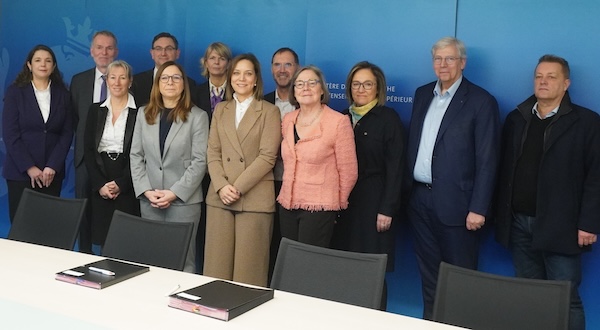
 Credit: MESR
On Thursday 5 February 2026, Luxembourg's Ministry of Research and Higher Education announced the signing of multiannual agreements for the 2026-2029 period, representing a total State commitment of €1,987.2 million to the University of Luxembourg and the country’s public research institutions.
The agreements were signed by Minister for Research and Higher Education Stéphanie Obertin and cover the University of Luxembourg, the Luxembourg Institute of Science and Technology (LIST), the Luxembourg Institute of Health (LIH), the Luxembourg Institute of Socio-Economic Research (LISER), as well as the National Research Fund (FNR). They define the institutions’ missions, strategic objectives and performance indicators, linking public funding to expected scientific, economic and societal outcomes over the four-year period.
According to the ministry, the agreements were negotiated in parallel in order to ensure greater coherence between the commitments of the various stakeholders, notably through harmonised definitions of objectives and indicators. As with previous multiannual agreements, the new framework links public investment in higher education, research and innovation to expected scientific, economic and societal outcomes, while further strengthening impact-oriented objectives.
The 2026-2029 agreements concluded with the University of Luxembourg and the public research centres define their missions, strategic objectives and the indicators used to assess their implementation. These indicators are grouped into three categories: financial, results-oriented and structural.
For the first time, the new agreements introduce structured obligations relating to the implementation of measures aimed at strengthening well-being, professional development and the quality of the working environment.
While the overall logic of the National Research Fund’s (FNR) multiannual agreement remains similar, its objectives and indicators differ due to its specific role as the national research funding agency. In this context, the financial component represents the central element of the agreement.
According to the ministry, the funding provided under the multiannual agreements is distributed among the beneficiary institutions as follows:
- University of Luxembourg: €261.0 million (2026), €267.5 million (2027), €277.4 million (2028) and €285.9 million (2029), totalling €1,091.8 million;
- LIST: €59.5 million (2026), €61.4 million (2027), €63.4 million (2028) and €65.1 million (2029), totalling €249.4 million;
- LIH: €49.6 million (2026), €51.3 million (2027), €53.2 million (2028) and €54.7 million (2029), totalling €208.8 million;
- LISER: €17.8 million (2026), €18.5 million (2027), €19.1 million (2028) and €19.8 million (2029), totalling €75.2 million;
- FNR: €84.0 million (2026), €88.2 million (2027), €92.6 million (2028) and €97.2 million (2029), totalling €362.0 million.
The ministry added that the multiannual agreements are fully aligned with Luxembourg’s National Research and Innovation Strategy, adopted in December 2019 and revised in January 2026, as well as with the three strategies underpinning Digital Sovereignty 2030, namely Luxembourg’s data strategy, the national quantum technologies strategy and the national artificial intelligence strategy.
“With these multiannual agreements, we are sustainably strengthening Luxembourg’s research and innovation ecosystem. The resources committed demonstrate the Government’s confidence in our institutions and our shared ambition: to produce excellent research, train the talents of tomorrow and support the country’s economic and societal development,” Minister Obertin stated.