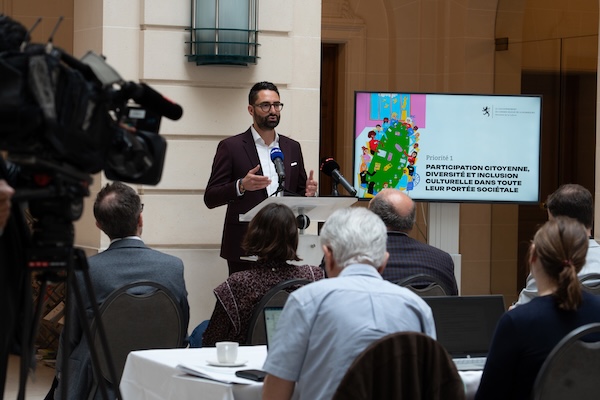
 Eric Thill, Luxembourg’s Minister of Culture;
Credit: MCULT
Eric Thill, Luxembourg’s Minister of Culture;
Credit: MCULT
On Tuesday 21 April 2026, Luxembourg’s Minister of Culture, Eric Thill, presented the national action plan “Access to culture” during a press conference at the Ministry of Culture.
According to Luxembourg’s Ministry of Culture, this plan defines 99 concrete actions to be implemented by 2030 to democratise access to culture in Luxembourg and is primarily aimed at audiences who are currently the most distant from it.
The minister recalled that, in a context marked by multiple tensions, culture plays more than ever an essential role. He said: “Culture connects, soothes and brings people together; it opens spaces for dialogue, respect and mutual understanding. Culture is one of the pillars of our social cohesion and the foundation of our living together.”
Access to culture now stands as a fundamental principle, anchored in the Constitution since 2023 and in line with Luxembourg’s international commitments, noted the ministry.
Based on scientific data from three surveys conducted between 2023 and 2025, the ministry highlighted one observation, which showcases that despite a rich, diverse and high-quality cultural offer, structural barriers remain and continue to hinder access to culture for certain audiences.
In this context, the ministry launched a clearly participatory approach by mobilising the entire cultural sector through “Assises culturelles 2025” (the cultural conference), which focused on access to culture and brought together more than 300 participants, marking the start of a collective dynamic around this priority issue, after which a broad consultation phase took place over several months through a series of consultations, workshops and exchange formats.
The plan is organised around seven priorities, broken down into 33 objectives and 99 concrete actions to be implemented progressively between 2026 and 2030.
According to the ministry, its first aim is to remove barriers that still limit access to culture for certain groups, whether for physical, socio-economic, geographical or symbolic reasons. The ministry further explained that the plan, overall, is based on a combination of structural actions, such as strengthening the presence of culture in school pathways and social measures like the Kulturpass, in order to reach the most concerned audiences. In addition, it said, that the targeted investments in pilot projects will help to identify the most effective solutions before scaling them up.
At the same time, the plan aims to strengthen the role of artists by promoting networking, increasing visibility and developing suitable working infrastructures across the country.
The ministry pointed out that, the action plan also aligns with the "Kulturentwécklungsplang" 2018-2028 (KEP) by addressing key areas such as education, culture in the regions and accessibility, while implementing thirteen of its recommendations, and it supports the coalition agreement 2023-2028 by prioritising nine cultural commitments.