 PANEL:
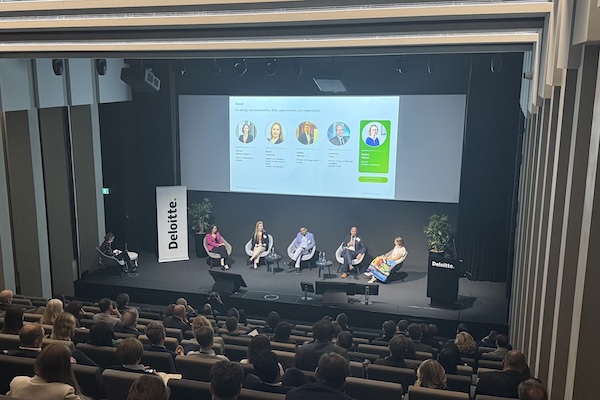
AI, energy, and sustainability: Risks, opportunities, and responsibility;
Credit: Ievgenii Karanov, Chronicle.lu
PANEL:
AI, energy, and sustainability: Risks, opportunities, and responsibility;
Credit: Ievgenii Karanov, Chronicle.lu
On Monday 11 May 2026, Deloitte Luxembourg hosted the fifth edition of the MOMENTUM Conference at its premises in Luxembourg-Gasperich, featuring a keynote speech by Serge Wilmes, Luxembourg’s Minister of the Environment, Climate and Biodiversity.
The event brought together around 80 guests and focused on the concrete steps needed in policymaking, strategy and operations to advance sustainability in Luxembourg and beyond. This year’s agenda explored the evolution of the global sustainability and ESG agenda, Luxembourg’s role in sustainable finance, and the intersection of artificial intelligence, energy and sustainability.
“Now we are in a harder phase: delivery. This is where targets meet infrastructure, where policy meets energy prices, where capital allocation meets political reality, where good intentions are invited to sit down at the same table as physics, economics and human behaviour,” said John Psaila, CEO and Managing Partner of Deloitte Luxembourg, during what he noted would be his final MOMENTUM Conference before Joachim Heukmes succeeds him in the role on 1 June 2026.
Referring to this year’s theme, “Rethink, Redraw, Reorient”, he described sustainability as “the real business”, rather than “a fashion” or “an elegant annex to the real business of business”. He also highlighted the growing importance of balancing artificial intelligence development with sustainability goals, noting that AI infrastructure requires significant energy, water and physical resources.
John Psaila further underlined Luxembourg’s role in sustainable finance, stating that the country has helped “turn sustainability from aspiration into instruments” through its investment fund industry, market infrastructure and expertise in green and responsible finance.
In his keynote speech, Minister Wilmes said that while Europe is currently “rethinking and redrawing” the path towards sustainability, the objective of climate neutrality by 2050 “has not changed”. He stressed that climate neutrality remains essential for “our safety, our wellbeing, our economy and ecosystems” and described sustainable growth as “the only way” for Luxembourg and Europe to remain competitive in the future.
The minister also highlighted the importance of balancing climate ambitions, competitiveness and social fairness, while stressing that Luxembourg’s climate policies continue to be guided by scientific research and long-term planning, including the national energy and climate plan, adaptation strategies and cooperation with research institutions such as the University of Luxembourg, LIST and LISER.
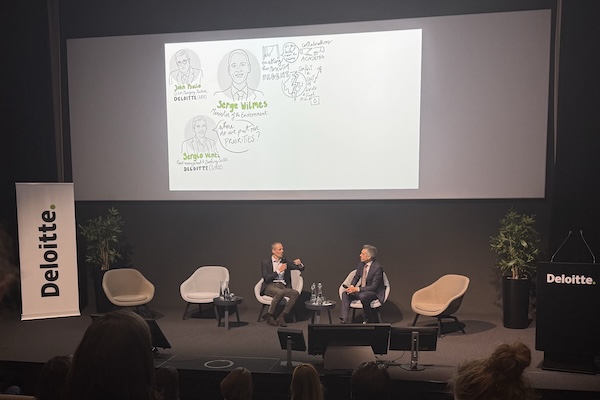
During a discussion moderated by Sergio Venti, Partner for the Asset Management and Banking sectors at Deloitte Luxembourg, Minister Wilmes addressed the balance between sustainability ambitions, competitiveness and regulation in Europe. While stressing that Luxembourg is “not against regulation”, he said the country advocates a pragmatic approach to avoid excessive administrative burdens for businesses while maintaining strong environmental protections.
Speaking about energy policy, the minister underlined Luxembourg’s need to reduce dependence on fossil fuels and continue investing in renewable energy, electricity grids and European energy interconnections. He also described Luxembourg as an “honest broker” within the European Union, supporting climate neutrality objectives while seeking predictable and stable policies for businesses and investors.
During the panel discussion on artificial intelligence, energy and sustainability, moderated by Bettina Werner, Partner for Sustainability Transformation at Deloitte Luxembourg, Johannes Trüby, Partner for Energy Markets and Modelling at Deloitte France, described electrification combined with renewable energy as “the path forward”, arguing that it would make energy systems “more resilient, cleaner, and also more affordable”.
Jeanne Michon-Savarit, Head of Sustainability at Infranity, said the growth of data centres and AI infrastructure needed to be managed responsibly, arguing that sustainability-focused investors have a key role to play in mitigating environmental and social impacts, including energy consumption, water usage and biodiversity concerns.
Representing Amazon Web Services (AWS), Roisin Greening, Public Policy Manager for Energy & Infrastructure EMEA, highlighted the company’s investments in renewable and carbon-free energy projects, as well as efforts to improve the energy and water efficiency of data centres. She noted that AWS infrastructure is “up to 4.1 times more energy efficient than a market-driven data centre”.
Aditya Sharma, Director of Strategy at Boson Energy, argued that Europe’s energy transition strategy must adapt to geopolitical disruptions and the rapid rise of AI-driven electricity demand, warning against excessive dependence on critical materials required for renewable technologies.
The conference concluded with closing remarks from Joachim Heukmes, Managing Partner-elect of Deloitte Luxembourg, before participants continued discussions during a networking cocktail.
(Caption: (L-R) Serge Wilmes, Luxembourg's Minister of the Environment, Climate and Biodiversity; Sergio Venti, Partner, Asset Management and Banking sectors at Deloitte Luxembourg; Credit: Ievgenii Karanov)