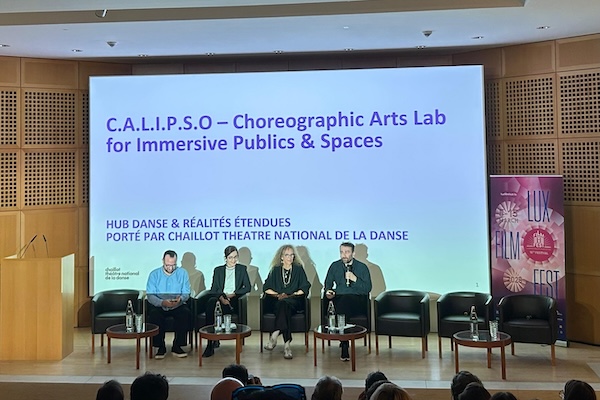
 (L-R) Philippe Rivière, Digital Director at Art Explora; Myriam Achard, PR at the PHI Centre in Montreal; Christelle Havranek, Chief Curator at Kunsthalle Praha; Pierre Lungheretti, Deputy Director of the Théâtre National de Chaillot;
Credit: Elza Osmane, Chronicle.lu
(L-R) Philippe Rivière, Digital Director at Art Explora; Myriam Achard, PR at the PHI Centre in Montreal; Christelle Havranek, Chief Curator at Kunsthalle Praha; Pierre Lungheretti, Deputy Director of the Théâtre National de Chaillot;
Credit: Elza Osmane, Chronicle.lu
On Wednesday 4 March 2026, the Luxembourg City Film Festival (LuxFilmFest) opened the first day of “Immersive Days 2026” at Mudam in Luxembourg-Kirchberg, ahead of the launch of the tenth edition of the “Immersive Pavilion 2026”.
The two-day programme features conferences, panels and networking events focusing on virtual reality (VR) and immersive technologies. The organisers aim to bring together experts and professionals to exchange views on topics including funding mechanisms, artistic approaches and distribution channels in the extended reality (XR) sector.
The opening panel gathered around 150 attendees and began with remarks from Guy Daleiden, Director of Film Fund Luxembourg. He noted that this marked the first seminar organised at Mudam within the framework of the festival.
“The idea was to show works in virtual reality, augmented reality and mixed reality, and to support them through the national foundation supporting production,” he said, adding that the programme also aims to attract audiences by presenting projects created in Luxembourg together with internationally recognised works.
Myriam Achard, Chief of New Media Partnerships and Public Relations at the PHI Centre in Montreal in Canada, then outlined the day’s programme and presented the exhibition locations across the city. Two immersive works appear at Mudam, while eight projects are presented at Abbaye de Neumünster (neimënster) in Luxembourg-Grund. Another installation appears at Villa Vauban in Luxembourg-Ville.
The programme continued with a panel discussion titled “How Immersive Technologies Are Transforming Spaces and Audiences: Case Studies from Museums and Theatres”, which explored how cultural institutions integrate immersive technologies to expand audience experiences.
Moderated by Philippe Rivière, Digital Director at Art Explora, the panel featured Pierre Lungheretti, Deputy Director of the Théâtre National de Chaillot in Paris, France, Christelle Havranek, Chief Curator at Kunsthalle Praha, and Myriam Achard.
Pierre Guérin addressed how immersive technologies can expand creative possibilities in choreography. He explained that the institution plans to develop a digital laboratory designed as a space for experimentation and collaboration where choreographers can explore the artistic potential of new technologies.
He also acknowledged that parts of the live performance sector still show hesitation toward digital tools. “There is a form of technophobia on the part of some artists who consider that it is foreign to them and not their universe at all,” he said, adding that the initiative aims to encourage artists to engage with immersive technologies.
Christelle Havranek then presented the approach of the Czech Republic’s Kunsthalle Praha, to immersive and digital art within its recently opened exhibition space. She described how the institution transformed a 1930s power station in central Prague into a contemporary art centre while preserving elements of its industrial history. “This building was an old power station created during a time of massive electrification of the city,” she explained, adding that the site’s history continues to influence exhibitions exploring technology, energy and digital art.
The programme continued with the next panel featuring artists behind several VR installations, who presented their projects and discussed their artistic approaches.