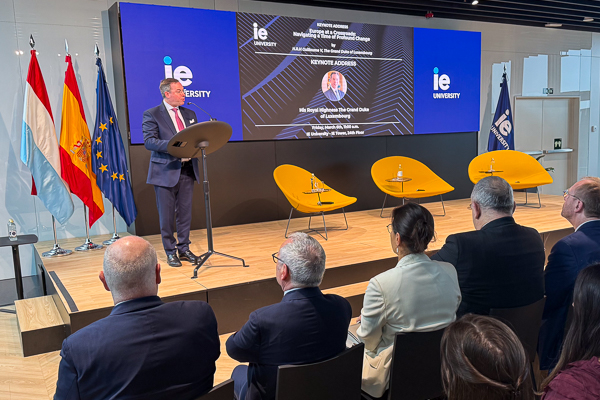
 Grand Duke Guillaume;
Credit: Ievgenii Karanov, Chronicle.lu
Grand Duke Guillaume;
Credit: Ievgenii Karanov, Chronicle.lu
On Friday 6 March 2026, the second day of Grand Duke Guillaume and Grand Duchess Stéphanie’s visit to Madrid was devoted to academic exchanges, including a visit to IE University by the Grand Ducal couple and the Luxembourg government delegation.
Located in the Spanish capital, the university has expanded its range of programmes while maintaining a strong focus on innovation, entrepreneurship and the training of internationally oriented leaders. It currently hosts around 10,000 students, professors and researchers from more than 160 countries and maintains a wide network of academic partners around the world.
Chief Executive Officer Diego del Alcázar Benjumea, Rector of IE University Manuel Muñiz and Dean of the IE School of Politics, Economics and Global Affairs Enrico Letta welcomed Grand Duke Guillaume and Grand Duchess Stéphanie, accompanied by Luxembourg’s Minister of Finance, Gilles Roth, and Minister of the Economy, SMEs, Energy and Tourism, Lex Delles, for a brief guided tour of the IE Tower, the Madrid campus inaugurated in 2021 in the heart of the capital’s financial district. The visit was followed by a working meeting.
While preparations were underway for the speech, Luxembourg media representatives and students gathered inside the IE Tower auditorium. Among them were around 30 students from the Grand Duchy currently studying at the university.
One of them, Theo Huart, a first-year Bachelor in Business Administration student at IE University, told Chronicle.lu why the moment was special for him: “I’m really excited to meet the Grand Duke. Since I’m from Luxembourg, it’s really an honour for me to see him here in Madrid at my university.” He added that the address would be particularly interesting in light of current global developments: “With what’s happening right now in, for example, Iran, Ukraine and other countries, there are many issues we need to understand and try to find solutions for. I think it will be a really interesting topic.”
In his opening remarks, Manuel Muñiz reflected on the broader geopolitical context in which the discussion was taking place, noting that Europe and the wider international order are facing a period of profound change. “We gather today here at a time when history is once again in motion,” he said, referring to the return of war to the European continent and growing instability in other regions.
He also highlighted the role of academic institutions in helping societies navigate such transformations, stressing that universities contribute by encouraging rigorous debate and reflection on the future of Europe. Quoting Luxembourg-born European statesman Robert Schuman, he noted that European integration “will be built through concrete achievements, which first create a de facto solidarity,” adding that Luxembourg has long played a distinctive role in Europe’s institutional foundations and commitment to integration.
Luxembourg’s Head of State then addressed students, academics and guests gathered at IE University, touching on several of the themes raised earlier in the discussion, including Europe’s role in an increasingly uncertain geopolitical environment.
In his speech, Grand Duke Guillaume reflected on the values underpinning the European project and Luxembourg’s place within it. He described the European Union as “one of the most ambitious expressions of the Enlightenment belief in reason, human dignity and the rule of law,” while warning that Europe faces serious challenges, including “a war of aggression on our continent, an escalation of hostilities in the Middle East and trade tensions.”
Addressing the students directly, he emphasised the importance of shared principles for Europe’s future: “Values offer a common compass of a shared vision to pursue, together.”
The Grand Duke also highlighted the role of young Europeans in shaping the continent’s future, noting that those “born into the European Union” carry the spirit of cooperation and responsibility that will help guide the next chapter of the European project.
The speech was followed by a question-and-answer session with students, attended by Luxembourg’s Ministers Lex Delles and Gilles Roth. Luxembourg’s Deputy Prime Minister and Minister for Foreign Affairs and Foreign Trade, Xavier Bettel, was not present, having departed Madrid the previous evening.
Students raised a range of topics, including talent retention, Europe’s economic competitiveness, the future of the EU Single Market, artificial intelligence and Europe’s role in an increasingly fragmented global economy.
Responding to a question about young Luxembourgers studying abroad, Minister Delles highlighted the importance of attracting and retaining talent, noting that Luxembourg is developing a strategy focused on education, retention and international talent attraction. “When we speak about talent, we speak not only about attraction, but also about education and retaining talent,” he said.
Minister of Finance Gilles Roth addressed questions related to Europe’s economic competitiveness and the role of Luxembourg’s financial sector. He stressed the importance of mobilising private capital to support strategic investments in Europe, noting that Luxembourg’s financial centre can help channel investment into infrastructure and innovation. “Luxembourg is a huge and unique financial hub and we can serve Europe with the tools we have in place,” he said.
Energy security and geopolitical tensions were also discussed. Minister Delles pointed to the need for greater European resilience through renewable energy and stronger cooperation within the EU energy market. “When we are more resilient and less dependent on decisions taken outside Europe, we are stronger,” he said.
Speaking about the European Single Market, Minister of Finance Gilles Roth also stressed the importance of fully implementing the principle of free movement of capital and services across the EU. According to him, stronger financial integration would allow Europe to channel more investment into major infrastructure and economic development projects.
The discussion also touched on artificial intelligence and technological competitiveness. Minister Delles noted that Luxembourg is investing in AI infrastructure and talent development, including support schemes aimed at helping companies adopt new technologies. “All companies will have to use AI in the future,” he said.
This was followed by a networking reception with Luxembourg's students, during which around twenty young Luxembourgers had the opportunity to meet and exchange a few words with the Grand Ducal couple for about half an hour, bringing the visit to Madrid to a close.