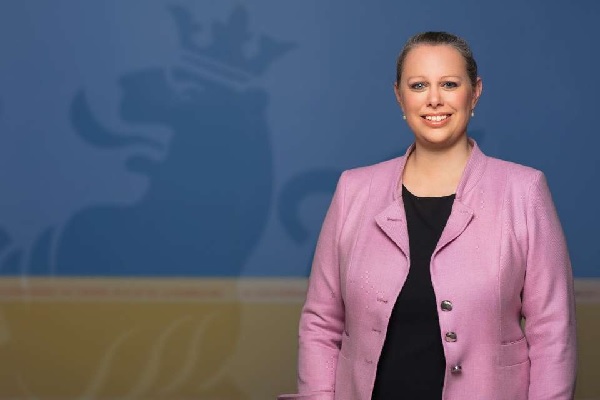
 Environment Minister Carole Dieschbourg has been accused of misconduct;
Credit: Luxembourg Government
Environment Minister Carole Dieschbourg has been accused of misconduct;
Credit: Luxembourg Government
On Friday 23 October 2020, Carole Dieschbourg, Luxembourg's Minister of the Environment, Climate and Sustainable Development, participated in the first Environment Council of Ministers under the German Presidency of the EU.
One of the main items on the Council's agenda was the European climate law. The objective of the Luxembourg delegation was to see the discussions on this new law progress as much as possible and to adopt a common and ambitious position at Council level, with a view to the next phase of negotiations with the European Parliament and in awaiting a decision from the European Council on updating the European Union climate objective for 2030.
In the afternoon, the Council adopted conclusions on biodiversity which will provide political guidance on the implementation of the EU's biodiversity strategy for 2030.
Finally, the European Commission among others presented its communication on an EU strategy for more sustainability in the field of chemicals.
Luxembourg's position in relation to European climate law
In her speech, Minister Dieschbourg emphasised that a European climate law must lay the legal basis for several key elements:
- First: The clarification that the objective of climate neutrality by 2050 must apply as much to the EU as to its member states, while providing for intra-European flexibilities so that this goal can be achieved by each member state. As for the very long term, the Minister joined colleagues who have supported the EU's commitment now to achieve negative emissions beyond 2050, i.e. that gas removals at greenhouse effect by forests, etc., exceed emissions in volume. This is to be as clear as possible now to citizens and economic actors of the regulatory and political framework to be expected also in the years and decades to come.
- Second: An EU climate target for 2030 revised upwards to a minimum of 55% real emission reductions, to be achieved in the EU. The Minister recalled that this was the bare minimum, to align with the objective of climate neutrality for 2050 and to prevent the objective recommended by the scientific community, namely to limit the rise in overall temperature at 1.5°C is put out of range.
- Third: Intermediate objectives and a revision cycle of these objectives, following the 5-year cycle that the signatory countries agreed to under the Paris agreement, in order to be able to align with the most recent scientific knowledge and to be able to improve the performance of different tools.
Despite the unresolved points to date, Luxembourg supported the adoption of the partial general approach as the Minister considered it important to be able to start negotiations with the European Parliament on this text as soon as possible.
An agreement at European level on raising the EU's climate ambition for 2030 is needed as soon as possible, so that the EU can submit this decision to the United Nations before the end of 2020 and inspire other big emitters of greenhouse gases do the same.
During the negotiations, Minister Dieschbourg opposed the inclusion of technological neutrality in the text, a coded and indirect language in particular in favour of nuclear energy. In this context, the Minister recalled that for Luxembourg nuclear power is not a solution and joined the Austrian position, asking to make explicit at the text level the fundamental principles of the European treaties under the environmental aspect, namely the principle of precaution and preventive action against risks, repairing environmental damage and the polluter pays.
Luxembourg's position in relation to the conclusions on biodiversity
For Minister Dieschbourg, the term "need for urgent action" is well chosen, because the urgency to take strong measures to curb the curve of decline in biodiversity is extreme.
To deal with this, the minister called for the creation of a network of legally-binding protected areas of at least 30% of the land and sea surface, of which 10% is under strict protection. While this is indeed a collective effort at EU level, it will nevertheless be necessary to ensure that each Member State participates actively and on a fair basis. At the same time, this fight must be fought at the global level during the next Conference of the Parties to the Convention on Biological Diversity. This is the reason why Luxembourg joined the coalition with high ambition for nature and people and supports the 10 transformative points of the "leaders pledge" signed at the biodiversity summit.
However, Minister Dieschbourg also insisted on the fact that the decisive element in the biodiversity emergency does not only concern the 30% protected, but the remaining 70% of the territory's surface. Here, Europe will have to be able to support the transition to truly sustainable practices. It will have to make organic farming and agrocology the basis of the future common agricultural policy, resulting in a radical reduction of at least 50% in the use of chemical pesticides. Europe will need to apply close-to-nature forestry everywhere to increase the resilience of our forests and protect our old and last primary forests.
The Luxembourg position can therefore be summarised by the formula, that it will be necessary to devote 30% of efforts to the 30% of protected areas, and 70% of efforts to the remaining 70%.
With this in mind, Luxembourg has unsuccessfully proposed to refer to biodiversity in the new 'Recovery and Resilience Facility' in order to make the Union's economies more sustainable. This is felt to be a missed opportunity to make the Union budget better equipped to face the challenges posed by the ecological transition. Luxembourg's position is that it will absolutely be necessary to ensure that we no longer fall into old patterns and get out of a double loser game between biodiversity and economic growth. Biodiversity should be one of the priorities in the future multiannual financial framework (2021-2027).
In conclusion, Minister Dieschbourg was convinced that transformative change must be radical and immediate. The adoption of the conclusions, for which the Minister thanked the German Presidency for its excellent work, is, however, an important step in the right direction.
Other talking points
In a joint intervention, Luxembourg and other committed Member States welcomed the EU strategy for more sustainability in the field of chemicals. The Grand Duchy, together with these Member States have, for many years, been pushing for an ambitious chemical strategy which will prevent the harmful effects of chemicals on human health and the environment. The strategy provides a good basis for moving forward and improving EU legislation, with its action plan accompanied by concrete measures, especially in the area of endocrine disruptors, dangerous products in articles, including import and export, the combined effects and very persistent chemicals such as the so-called "per- and poly-fluoroalkylated" substances.
Finally, Luxembourg supported a proposal to modify the Aarhus Convention. In order to enable NGOs working in environmental matters to assume their role, access to justice is a crucial tool. By limiting access to justice to only individual acts directly concerning NGOs, the Aarhus Regulation is the subject of much criticism of the Aarhus Convention. The proposed amendment addresses the recommendations of the Aarhus Convention Compliance Review Committee, providing expanded access to European courts through this regulation.