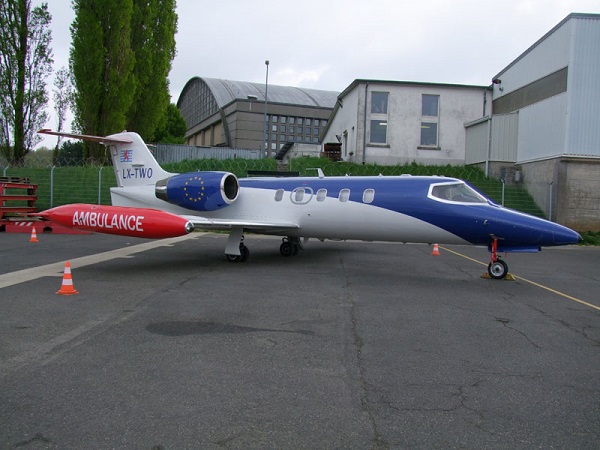
 LAR Air Ambulance;
Credit: Chronicle.lu
LAR Air Ambulance;
Credit: Chronicle.lu
On Sunday 4 January 2026, Luxembourg's Directorate for Development Cooperation and Humanitarian Action, together with the Ministry of Foreign and European Affairs, Defence, Cooperation and Foreign Trade (MFA), confirmed that Luxembourg Air Rescue (LAR) has been involved in an evacuation of those involved in the fatal New Year's Eve fire in Crans-Montana, Switzerland, as part of the Emergency.lu initiative.
According to the latest figures, the fire that broke out in Crans-Montana on New Year's Eve has claimed 40 lives and left 119 injured.
According to the press release, this tragedy demonstrates the critical need for assistance from third countries, given the large number of burn victims. Switzerland has therefore activated the European Civil Protection Mechanism to ensure the evacuation of the seriously injured to appropriate facilities abroad.
As part of its emergency.lu programme, the ministry commissioned Luxembourg Air Rescue (LAR) to support the operation with its medical evacuation capabilities.
On the night of Friday 2 January 2026, following a pre-alert from emergency.lu, the LAR operations control centre immediately verified its availability and placed its air and medical crews on alert, with an anaesthesiologist-resuscitator and two specialised nurses on board, to ensure optimal care for severely burned patients.
On 2 January 2026, in close coordination between the Directorate for Development Cooperation and Humanitarian Action of the Ministry of Foreign Affairs, the CGDIS (Grand-Ducal Fire and Rescue Corps), the EU Emergency Response Coordination Centre (ERCC), and LAR, the first person was evacuated from Payerne, Switzerland, to a specialised facility in Leipzig, Germany.
On Saturday 3 January, a second patient was transferred from Zurich to Berlin, Germany.
How does the EU provide assistance in the area of civil protection?
In an emergency, national authorities can activate the EU Civil Protection Mechanism to enable coordinated assistance.
All EU Member States, as well as ten other participating countries (Albania, Bosnia and Herzegovina, Iceland, North Macedonia, Moldova, Montenegro, Norway, Serbia, Turkey and Ukraine), participate in the Mechanism.
The EU also has a coordination centre, the Emergency Response Coordination Centre (ERCC), which manages all requests for assistance. The ERCC continually monitors emergencies worldwide. It is ready to centralise assistance provided by participating countries when needed.
The EU also co-finances the operational and transport costs of aid delivered through this mechanism.
Emergency.lu
Since its creation in 2012, evolving from a satellite communications platform, emergency.lu has become the operational arm of Luxembourg's humanitarian action. Its missions now cover the storage of humanitarian supplies, medical evacuations, logistical and infrastructural support for humanitarian organisations, as well as emergency telecommunications.
Luxembourg Air Rescue
Founded in 1988, the non-profit organisation Luxembourg Air Rescue (LAR) has approximately 185,000 members and operates a fleet of modern rescue helicopters and air ambulances. Its mission is to save lives in Luxembourg, the Greater Region and internationally, guaranteeing continual operational availability thanks to nearly 200 employees.
Updated to correct the first date.