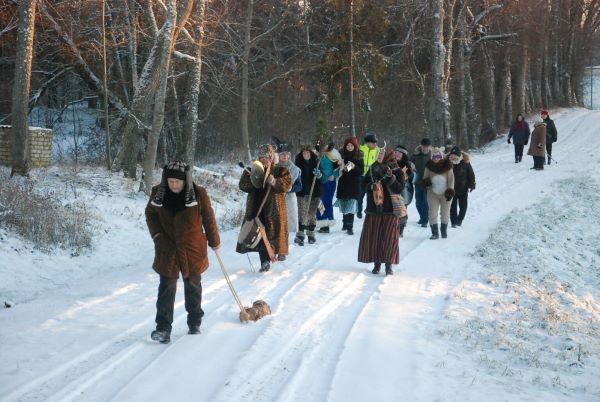
 Yule log pulling tradition;
Credit: Uldis Dobelis
Yule log pulling tradition;
Credit: Uldis Dobelis
Christmas is a widely known celebration, commonly associated with presents, holidays, family reunions, markets and other customs; in Luxembourg, 25 and 26 December are public holidays.
Alongside contemporary customs of gift-giving and festivities, Christmas is primarily known as a Christian celebration of the birth of Jesus. However, my childhood memories involve certain traditions that date back to much older beliefs. Not only in my home country Latvia but also across the Baltic states (Latvia, Lithuania and Estonia), together with their northern neighbour Finland, Christmas is an example of how Christian traditions coexist with ancient pagan rituals, while church and faith still remain important for many people.
In all those four countries, Christmas Eve on 24 December is the most important celebration day, usually spent only with close family members, centred around the dinner table and symbolic customs rather than loud festivities.
In Latvia, Christmas Eve dinner traditionally consists of nine dishes, while in Lithuania there are twelve. Number nine is sacred in Latvian folklore and represents completeness, wholeness and the cycle of life. In Lithuania, Christians often relate the twelve dishes to the twelve Apostles, while others believe the number is more closely connected to the twelve months of the year, pointing to pagan origins.
In both countries, there is a custom to eat at least a small amount of every dish. Otherwise, it is believed that a person may lack food in the coming year. Those following Christians beliefs avoid meat, while others, following the ancient practice, prefer not to risk lacking meat the following year and therefore include it in the meal.
Another shared element in Latvia and Lithuania, inherited from pagan traditions, is the celebration of the winter solstice in addition to the official Christmas holidays. This takes place on the shortest day of the year, which can vary slightly each year, around 22 December. One of the rituals that day is making a bonfire, dedicated to “helping” the sun turn towards the light. Ancient peoples believed that human participation in the processes of nature was important, as it closely affected processes going on in forests and fields.
Other customs include, eating carp and keeping some of the dried scales in a wallet, as tradition says this brings money and prosperity, as well as performing “bluķa vilkšana” (pulling the Yule log). A large log is tied to a rope and dragged around the homestead or sometimes through the village. Symbolically, the log collects all the misfortune, worries and bad energy of the past year and then, burned in a bonfire, destroys everything negative and clears the way for the new year.
Lithuanian traditions also include the belief in feeding the dead. If there are deceased family members, it is customary to place an extra plate on the table for them.
In comparison, Estonia and Finland are generally more practical in their customs. There is no fixed number of dishes on their dinner table and less emphasis on symbolic meals, keeping modern elements minimal as well. Instead, the focus is on sauna, fire and household rituals throughout the holidays. Both countries follow a similar pattern, emphasising calm, warmth and reflection during the darkest time of the year.
After living through three winters of vibrant Christmas celebrations in Lapland, I learned that Finland’s customs differ noticeably between the south and the north. Lapland has become closely associated with endless Christmas and called the home of several fictional characters, such as Santa Claus and his elves. While much of this image is commercial, locals have embraced it, often learning and reshaping traditions through constant interaction with tourists visiting the North Pole in search of “Christmas magic”.
In southern Finland, particularly in Turku, Christmas takes on a more solemn character through the Declaration of Christmas Peace. First broadcast in 1935, the ceremony continues to attract thousands of people each year, both in person and through television broadcasts. The declaration calls for calm and respectful behaviour during the festive period and expresses solidarity with people beyond Finland, including those surviving in war zones and other conflict affected areas.