On Monday 18 July 2016 the Agriculture and Fisheries Council was held in Brussels, with Luxembourg’s Minister of Agriculture, Viticulture and Consumer Protection, Fernand Etgen, representing the Grand Duchy.
The first council under Slovak chairmanship was decisive in its outcome. Despite an improvement in the pork market, the situations remains serious with regards to the dairy sector. These difficulties are likely to persist at least until the end of this year, according to Luxembourg’s Ministry of Agriculture, Viticulture and Consumer Protection. The European Commission has thus decided to release additional EU funds for the EU dairy sector.
This new series of support measures, amounting to €500 million, is mainly based on two lines of action:
* €350 million of which €560,115 is designated for Luxembourg: They is temporary aid, mainly for the dairy sector, intended to stabilise the market and alleviate the plight of farmers;
* €150 million euros (managed at European level): This is aimed at limiting or reducing milk production in order to restore the balance between demand and supply.
Minister Etgen noted in this context that, although the financial framework is not up to the expectations of the sector, it is nevertheless an important political sign since this is the second package to the tune of €500 million in less than a year.
Regarding the national envelope of €560,115, Minister Etgen stressed that it was essential for him that maximum flexibility is given to Member States in order to take account of their individual specific circumstances and enable rapid allocation of the aid to producers. It may however be possible to use national top-ups of up to100%, which means that the envelope of €560,115 could be doubled with national funds.
Minister Etgen stated that he regrets that the Commission did not consider Luxembourg’s request to increase the threshold of the national “de minimis” aid from €15,000 to €30,000. This adjustment would have met the needs of the Luxembourgish farmers. As a result, Minister Etgen called on the Commission to reconsider the issue.
Another important topic raised during the the council was to simplify the EU's common agricultural policy (CAP) -more specifically in the area of a greening review at the end of the first year of implementation. Minister Etgen was in accordance with the Commission's political commitment to simplify the CAP rules, but insisted that simplification should represent a real improvement for both the farmer and the government. Any complications or tightening of existing rules, from the political compromise of the 2013 reform, will therefore not be accepted.
The EU ministers of agriculture also discussed the difficulties arising from the prohibition of the use of potassium phosphonate in organic agriculture and its particular impact on viticulture. The control of fungal diseases is an ongoing challenge. Minister Etgen, together with his German counterpart, therefore supported the Czech Republic’s request that the Commission review its position on the use of potassium phosphonate substance. This is because it both fertilises and has antifungal effects, which is in the interest of organic viticulture.
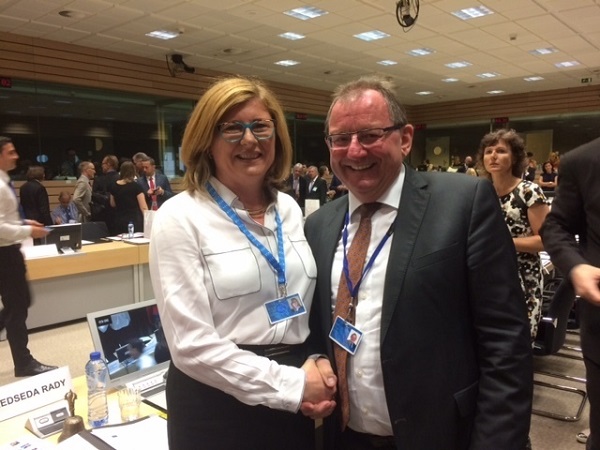
Photo by the Ministry of Agricultured. g. à d.: Gabriela Matecna, ministre slovaque de l'Agriculture et Fernand Etgen, ministre luxembourgeois de l'Agriculture, de la Viticulture et de la Protection des consommateurs