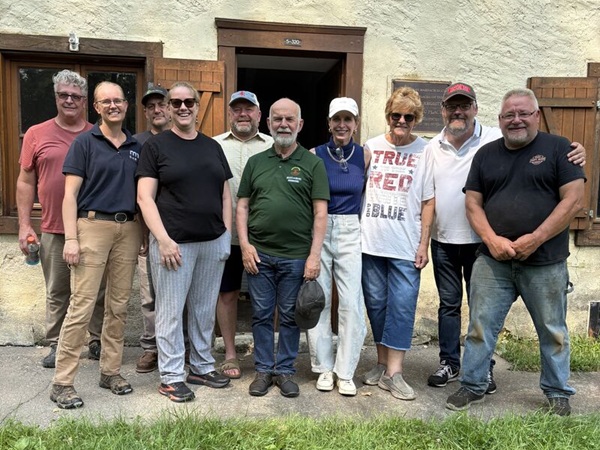
 Roots & Leaves with LACS in Us Midwest Leadership tour, 2026;
Credit: Roots & Leaves
Roots & Leaves with LACS in Us Midwest Leadership tour, 2026;
Credit: Roots & Leaves
A number of Luxembourg representatives travelled to the United States during August, first to participate in the 40th annual Luxembourg Fest organised by the Luxembourg American Cultural Society (LACS) in Belgium, Wisconsin, and then to travel through the Midwest.
Marc Zimer, Vice President of the Roots & Leaves Association based in the Grand Duchy, travelled with Carlo Krieger, President of Roots & Leaves, and Travis Gross, LACS Executive Director: this mission was to connect the Grand Duchy of Luxembourg with communities across the Midwest courtesy of this joint leadership tour, to preserve Luxembourg-American heritage which should be a starting point for creating new relationships.
Their journey took them through Rollingstone, Winona, New Ulm, Remsen, Dubuque, St. Donatus and Bellevue — places with fascinating Luxembourg connections, but also communities where there is great potential to build something new for the future.
This tour was not simply about looking back through Luxembourg's heritage, it was about connecting the past with the future. Throughout the journey, they met with people involved in heritage, education and their local communities. They listened to their stories, discussed new ideas and explored how they could strengthen cooperation between Luxembourg and the United States.
Their plan was to connect Luxembourg and Luxembourg-American communities, schools and educational institutions, colleges and universities, heritage societies and cultural organisations, cities and local communities, families and descendants of Luxembourg immigrants, and especially the next generation.
According to Marc Zimer, the Luxembourg immigrants who came to the Midwest generations ago created extraordinary connections between the two countries. Their stories can still be found in churches, cemeteries, historic homes, archives, family histories and entire communities across Minnesota and Iowa.
Chronicle.lu talked with Marc Zimer who, while not teaching at the Lenster Lycée in Junglinster, devotes his time to the Roots & Leaves association, mainly in developing connections though educational exchanges between schools and colleges in the two countries.
He explained: "The trip through the American Midwest grew out of work I have been developing for several years to strengthen connections between Luxembourg and the United States. As Vice President of Roots & Leaves, much of my own work has focused on creating connections between Luxembourg and American schools, universities, communities, heritage organisations and individuals".
He continued: "The purpose of this trip was therefore not simply to visit places associated with Luxembourg immigration. We wanted to see what remains of Luxembourg's heritage in the Midwest, meet the people who are preserving it, connect organisations that are sometimes working independently of one another, and above all ask an important question: How can we use this remarkable shared history to create new cooperation today?"
The following is presented in diary form of their visit.
Rollingstone and Winona
We began on Monday in Rollingstone, Minnesota, where we had lunch at Bonnie Rae's Cafe before visiting the local Luxembourg museum. Rollingstone is a particularly interesting place because Luxembourg heritage remains very visible in the community.
In the afternoon we visited the historic Marnach House, where we were joined by representatives and guests invited by the Minnesota Department of Natural Resources and Luxembourg Honorary Consul Kris Speltz. The Marnach House is an important physical reminder of Luxembourg settlement in south-eastern Minnesota and provides an excellent example of how an historic building can be used to tell the much larger story of immigration.
That evening we returned to Winona, where we had dinner with members of the Winona Rotary Club at Peter's Biergarten. Meetings like this are important because our work is not restricted to Luxembourg heritage organisations. If we want to develop lasting relationships, we also need to involve civic organisations and community leaders.
Tuesday was devoted largely to education. We started at Winona Senior High School, meeting Brad, the superintendent of Winona Public Schools, to discuss opportunities for educational co-operation and international exchanges. We then met Jessica Burros at the Winona State University Education Village, followed by a visit to the Minnesota Marine Art Museum, where we met Mike Linnemann. We had lunch together with Dr. Sorvaag, and afterwards met representatives of WSU International and toured the university.
These discussions were particularly valuable to me because education is one of the strongest ways of transforming historical relationships into something meaningful for a new generation. A Luxembourg connection that began through immigration 150 or 170 years ago can become the starting point for a student exchange, a teacher exchange, a university partnership or a research project today.
New Ulm and the Mankato Region
On Tuesday afternoon we travelled west to New Ulm, where we met members of the local association that evening.
The following morning began at New Ulm City Hall with Mayor Kathleen Backer. We then met John Kellen and visited his museum.
From New Ulm we travelled to Mankato, where we met representatives of the Minnesota State University in Mankato, before continuing through St. Peter and Sleepy Eye.
This part of the journey was particularly interesting because it demonstrated that Luxembourg-American connections should not be viewed in isolation. The Midwest contains communities with very strong European identities, and there is considerable potential for Luxembourg to become part of a broader network involving local government, education, culture and heritage.
Remsen and Le Mars
From Minnesota we continued south into Iowa, travelling to Remsen, where we had dinner with members of the local Luxembourg association.
Remsen is another important example of how Luxembourg identity survived far from Luxembourg itself. Meeting members of the local community allowed us not only to learn more about their history but also to discuss how these relationships can be renewed and strengthened.
The following morning we began at Gehlen Catholic High School, where we had breakfast and met Father Doug Klein, the school principal and other representatives.
This was another important educational meeting. For me, the question is always how we can take an historical connection and turn it into something practical for young people. Schools are an obvious place to start.
Our trip also attracted interest from the regional media. In Le Mars, we were interviewed by Peggy Senzarino, news editor of the Le Mars Daily Sentinel, and afterwards by Sean Power, news director at KLEM Radio.
The media interest itself was encouraging. It showed us that the Luxembourg story is not only interesting to people who already identify themselves as Luxembourg-American. It is part of the wider history of the Midwest and deserves greater visibility.
St. Donatus
From Le Mars we made the long drive east across Iowa to St. Donatus.
St. Donatus is an extraordinary place for anyone interested in Luxembourg-American history. The village, church, houses and surrounding landscape provide one of the most striking reminders of Luxembourg settlement in the United States.
We met Ron Hilkin, who showed us around St. Donatus and helped us understand the community and its history.
That evening we met at Kalmes Restaurant with members of the local board, community representatives, the mayor and others for dinner and, more importantly, a discussion about future cooperation.
This was exactly the type of conversation we wanted to encourage during the tour: not simply, What happened here in the past? but rather, What can we do together next?
Dubuque and Bellevue
Our final day began early in Dubuque, with breakfast together with representatives of the city.
At Loras College, we met representatives in the library and toured the college. Loras is particularly interesting because of its historical collections and because higher education can play an important role in researching and interpreting Luxembourg immigration.
We also visited Hempstead High School and met Abby Finkenauer, adding another educational and civic dimension to our discussions.
From Dubuque we continued to Bellevue, another community within the wider Luxembourg-American landscape along the Mississippi.
Conclusion
Marc Zimer explained to Chronicle.lu what he had learned from the journey. "Perhaps the strongest impression I took away from these days was the scale of the Luxembourg footprint in the Midwest. Luxembourg is a very small country, yet across Minnesota and Iowa we encountered communities, families, churches, cemeteries, historic houses, museums, schools and organisations whose stories are directly connected to Luxembourg. But I also realised that many of these connections exist almost like individual islands.
There are people doing excellent work in Rollingstone, Winona, New Ulm, Remsen, St. Donatus, Dubuque and elsewhere, but they do not necessarily know what the others are doing. The same is true when we look across the Atlantic. There are institutions in Luxembourg that could be natural partners for these American communities but where the connection has not yet been made. This is where I believe Roots & Leaves and LACS have an important role to play.
LACS has developed an extraordinary base for Luxembourg-American heritage and culture in the United States. Roots & Leaves provides a bridge from Luxembourg. By working together, we can help connect people who otherwise might never meet. For me, however, heritage is only the beginning. I am particularly interested in what comes after we rediscover these connections.
Can a Luxembourg school develop an exchange with a school in Minnesota or Iowa? Can university students study the history of Luxembourg immigration? Can teachers cooperate? Can communities develop cultural partnerships? Can young Luxembourg-Americans come to Luxembourg and discover where their ancestors came from? Can Luxembourg students travel to these communities and understand what happened to the Luxembourgers who left their country generations ago?
These are the kinds of bridges we want to build.
The trip also confirmed something I have learned repeatedly through my work in the United States: personal relationships are essential. Emails and online meetings are useful, but sitting around a table with a mayor, superintendent, university representative, teacher, historian or member of a Luxembourg-American association creates a completely different relationship.
Sometimes an entire project begins because two people meet and realise that they can help each other.
Over only five days, we moved constantly between history, education, local government, universities, community organisations and the media. At first these may appear to be separate areas, but in reality they are all pieces of the same puzzle.
The Luxembourg immigrants who came to the Midwest generations ago created the original bridge between Luxembourg and America.
Our goal today is not simply to admire that bridge from the past. We want people to cross it again."
ED