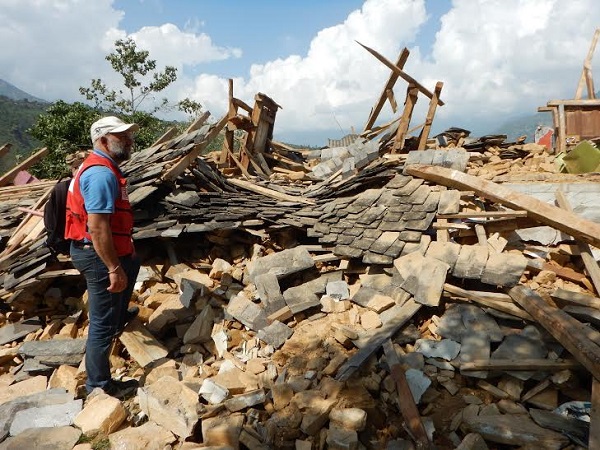
As the world's press becomes occupied by the earthquakes and aftershocks which continue to devastate the population of Ecuador, it becomes easy to forget about the 7.8 magnitude earthquake which struck Nepal a year ago and continues to hinder the livelihoods of those who were affected; with this in mind, the Luxembourg Red Cross released Friday a report on the aftermath of the natural disaster.
According to the Luxembourg Red Cross, around 4 million Nepalese are still living in precarious conditions a year on, with habitat remaining the major concern for humanitarian aid where more than 800,000 homes were destroyed or damaged during the disaster on 25 April 2016 which claimed thousands of lives.
A year ago, €465,000 donated by the Luxembourg public enabled the national Red Cross to immediately mobilise emergency aid for earthquake victims and provide assistance in the first months after the Luxembourg volunteers were deployed as part of the 'Emergency Response Unit Relief Benelux' of the Red Cross to coordinate aid distribution on the ground. The donations also helped finance the deployment of 500 Nepalese volunteers and the purchase and distribution of tarpaulins to 4,400 families to build temporary shelters. 40,000 families also benefitted from essential kits distributed by the Red Cross.
Assessing the damage and preparing reconstruction proved difficult due to landslides which blocked access to remote disaster areas and internal political tension. The Luxembourg Red Cross continues to work with its sister society in Nepal to rebuild destroyed houses up to anti-earthquake standards. This 8-year old cooperation led to the construction of earthquake-resistant houses in Nepal following the earthquake of 2011.
The last few months have seen support programmes launched, such as training masons in seismic construction technqiues, but the need to accelerate the sustainable reconstruction process is becoming increasingly pressing.
"Living under tarps was never considered a permanent solution," explained Dev Ratna Dhakwa, secretary general of the Nepalese Red Cross. "Our goal is to restore the dignity of the living conditions of these earthquake survivors. They need to be assured of the security of a propre home in the near future."
"Nepal is facing a very difficult situation in terms of the management of its post-emergency policy," continued Béatrice Winandy, humanitarian project manager of the Luxembourg Red Cross. "This delayed our project reconstruction and those of other humanitarian organisations. We hope to soo have clarity on the framework i which reconstruction aid can be deployed faster so that survivors can return to decent and sustainable living conditions."
The Nepalese Red Cross Society, along with sister associations, has already helped nearly 3 million people in the months following the earthquake. In 2015, the Luxembourg branch invested €167,000 in emergency aid to Nepal. In 2016, it initiated the first amount of €105,000 for the reconstruction programme. Over the course of the next two years, the aim of the Red Cross Societies will be to enable 500,000 Nepalese in 14 districts to return to safe living conditions.
As part of the international system, the Luxembourg Red Cross intervenes in the Dhading district. The project scheduled for 2016-2017, which receives financial assistance from the National Red Cross Societies of Monaco and Liechtenstein, aims to build 300 houses with latrines, reconstruct water and sewerage systems in the communities of Katunje and Reegaun, which will be equipped with water points. The project also includes training 30 masons under the 'Build back safer' technical programme and strengthening the voluntary skills of local branches of the Nepalese Red Cross through the Participatory Approach for Safe Shelter Awareness (PASSA) training programme.
Click here to find out how SOS Villages d'Enfants Monde has been supporting children and families in Nepal.
Photos by Luxembourg Red Cross