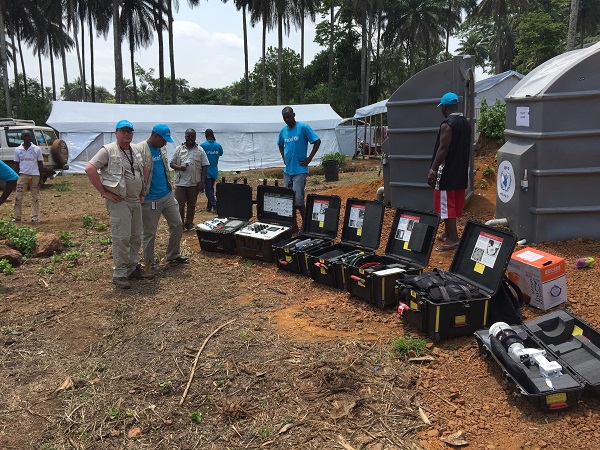
On Wednesday 30 March 2016, the Directorate of Development Cooperation and Humanitarian Action of the Luxembourg Ministry of Foreign and European Affairs made available to UNICEF a Rapid Deployment Satellite Terminal as part of the fight against the further spread of the Ebola epidemic in the Guinea region.
Despite the international humanitarian community celebrating 42 days with no new cases in Liberia in January earlier this year, UNICEF has reported nine new cases of the virus in Guinea in the Nzerekore region. The international organisation has therefore sought the assistance of the Luxembourg Cooperation and requested the provision of an 'emergency.lu' antenna as a means of overcoming the lack of mobile network and local internet service providers which is hindering the responsiveness of agencies - such as UNICEF, WHO, IOM and CDC - in the field.
The preconfigured and ready-to-deploy rapid response terminals provided by 'emergency.lu' will ensure wireless and mobile internet network for a team of 20 people in the Koropara office in the Nzerekore region. Two volunteers from the Emergency Services Administration have gone to Guinea until Tuesday 12 April 2016 in order to install the system.
When the Ebola crisis hit West Afriva in 2014 and 2015, Sierra Leone, Guinea and Liberia were particularly affected. More than 28,600 people have been infected and more than 11,300 killed. The Luxembourg Cooperation has provided funding to emergency programmes through UN agencies, including the WHO and the multi-stakeholder partnership of the UN Development Programme (UNDP). The Ministry of Foreign and European Affairs has contributed to the recovery of health systems, including Guinea.
Photo by MAEE