On Friday 11 March 2016, Médecins sans Frontières (MsF) Luxembourg presented a report on the 160,656 civilian victims of the Syrian war in 2015 , highlighting the toll of a conflict which is now in its fifth year.
MSF Luxembourg Director-General Paul Delaunois, who has made around ten trips to Syria to offer assistance to MSF efforts, reported on data from 69 of the 150 MSF-supported medical structures in the country, which recorded 154,647 injured and 7,009 killed in the conflict in 2015. Mr. Delaunois explained that these figures must be cautiously considered as estimations, due to the difficult nature of working in a war zone where credible reports and viable eyewitness accounts are not readily available and a comprehensive handle on the full extent of the disaster is unobtainable. What was made clear, however, is that "civilians are the main victims of the conflict", with between 30% and 40% of the victims women and children under the age of 15 who are not even directly involved in the fighting.
Despite MSF's continued efforts, providing humanitarian assistance in the field is repeatedly hindered through denied access or indiscriminate attacks on medical infrastructure. Indeed, in Damascus, one of MSF's primary areas which holds between 29-39 of their overall structures, the organisation has been seeking government approval to provide aid in the city since 2011 and has still not been authorised, forcing the NGO to perform its actions clandestinely. "We have had to change, modify our mode of operation," explained Paul Delaunois, adding that "we are in a completely unfamiliar situation" with an "unimaginable context".
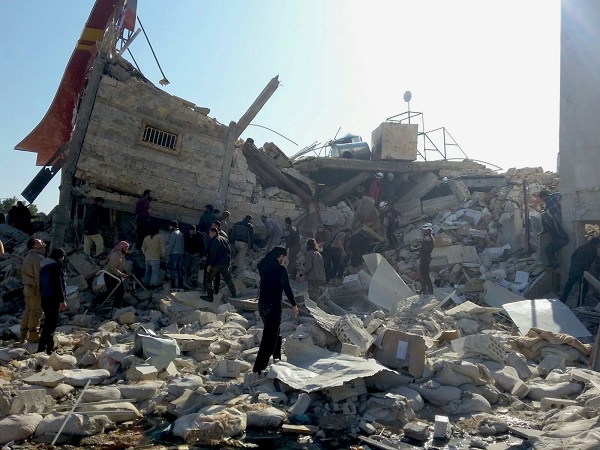
Constant hospital bombings present an even more significant, and traumatising, obstacle to humanitarian and medical assistance. MSF-supported infrastructure was involved in 94 attacks last year through air strikes and shelling, during which three were completely destroyed in May and 14 severely damaged in October in the northern and western parts of Syria. Futhermore, double impact attacks have also been carried out, as was the case in Douma on 13 December 2015 when an initial airstrike left 108 injured and 23 dead and was followed twenty minutes later by shell fire once emergency services arrived, leading to 79 more casualties and the deaths of a further 22 people.
According to MSF, these sorts of attacks destroy the morale of people working under these sorts of conditions, who themselves become victims of the conflict when merely doing their job. In 2015, 23 Syrian health staff were killed and 58 wounded, whilst only three months into 2016 a further seven strikes have been carried out on six MSF-supported medical facilities. "The people who work there, set out for work in the morning and cannot know if they will return," said Mr. Delanouis. In 2015, the international organisation submitted a petition demanding an independent internal investigation into an airstrike on Kunduz which destroyed an MSF hospital, killing 12 members of staff and 10 patients.
With such high figures becoming a constant definition of the Syrian conflict, it becomes hard to grasp the full extent of the nightmare which has become a reality. As Mr. Delaunois highlighted, the crisis has a global reach, with more than 6.6 million people having been displaced, with 4.6 million forced from their homes to seek refuge in neighbouring countries. Mr. Delanouis pointed out that whilst on the one hand United Nations Security Council member states vote every six months on resolutions to protect the civilian population and humanitarian action, on the hand these resolutions go largely ignored as four of the five permanent members - France, the Russian Federation, the United Kingdom and the United States - are carrying out air strikes and adding to the instability in the region.
Despite the glaring number of those pushed out of the country, Médecins sans Frontières estimates that around 1.9 million people are still present in besieged cities or zones, living in a state of perpetual fear. Attacks are often senseless and the resulting toll of dead or wounded are largely civilians who have no impact on or involvement in the actual fighting. One of MSF's most significant mass casualty influxes was in September 2015 when a playground in Homs was bombed, killing 24 people of which 90% were women and children, whilst an additional 86, of which again the overwhelming majority were women and children, were left wounded. "You have peaks and troughs, but it never stops," commented Paul Delaunois.
"The medical data documented in the report reveal an appalling reality," remarked Dr. Joanne Liu, international president of MSF. "The consistently high numbers of women and children - more than 900 wounded per week - puts beyond any doubt that civilian areas and infrastructure were either targeted or indiscriminately struck through the military campaigns in 2015."
MSF urged warring factions to cease attacks on civilians and public infrastructure, as well as enable medical and humanitarian teams to continue providing support without the looming threat of further attacks on medical centres. The association further demanded that humanitarian organisations be granted free access into besieged zones in order to carry our medical evacuations. MSF lastly stressed the need for resolutions to be unanimously enforced.
"Permanent members of the UN Security Council, four of whom are actively involved in the war in Syria, must answer for their failure to uphold their own resolutions, and must ensure the horror of 2015 is not repeated," affirmed Dr. Liu.
Top two photos provided by MSF; Bottom photo by Emma Terling (Paul Delanouis)