 14th Ceremony of the Luxembourg Peace Prize;
Credit: Ali Sahib, Chronicle.lu
14th Ceremony of the Luxembourg Peace Prize;
Credit: Ali Sahib, Chronicle.lu
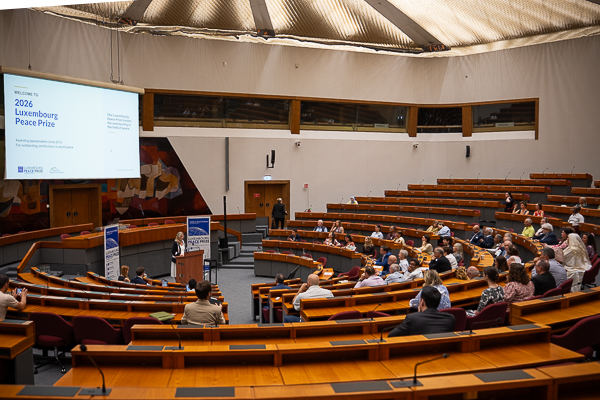
On Friday 19 June 2026, the Schengen Peace Foundation held the fourteenth edition of the Luxembourg Peace Prize at the Hémicycle of the European Convention Centre Luxembourg (ECCL) in Luxembourg-Kirchberg, bringing together more than 100 peace activists and guests from around the world.
The ceremony opened with welcoming remarks from Vicki Hansen, President of the Schengen Peace Foundation and the Luxembourg Peace Prize, who greeted the guests and participants gathered for the event.
Luxembourg City's First Alderman, Maurice Bauer, welcomed participants to the capital and highlighted Luxembourg's tradition of international cooperation and peaceful coexistence. Noting that residents of more than 160 nationalities live in the city and that over 70% of its population are foreign nationals, he described Luxembourg City as “a laboratory of peaceful living together”, where people from different backgrounds can live and work side by side. Bauer also reaffirmed the city's support for the Luxembourg Peace Prize and its organisers.
The ceremony also featured a presentation of the 2026 Global Peace Index (GPI) by Steve Killelea, Founder and Executive Chairman of the Institute for Economics & Peace (IEP). Presenting the findings of this year's report, he said global peacefulness had deteriorated for the twelfth consecutive year, with 99 of the 163 countries assessed recording a decline. According to the index, there are currently 65 active conflicts worldwide - the highest number since the end of the Second World War - while 103 countries have been involved in conflicts beyond their borders during the past five years.
Steve Killelea noted that Europe remains the world's most peaceful region, with six Western European countries ranking among the ten most peaceful nations globally. However, he warned of growing geopolitical fragmentation, a decline in the influence of traditional European powers and the rise of middle and emerging powers seeking greater strategic autonomy. He argued that international trade and economic ties, once regarded as drivers of peace, are increasingly being used as geopolitical tools through sanctions, trade restrictions and asset freezes.
The presentation also highlighted the growing impact of new technologies on modern warfare. Steve Killelea pointed to a sharp increase in the use of drones and artificial intelligence in conflicts, as well as the economic cost of violence, which the report estimates at $21.8 trillion in 2025, equivalent to 11.3% of global GDP. He also warned that escalating tensions in the Middle East and the Horn of Africa could further destabilise global security and have significant economic repercussions far beyond the regions directly affected.
Organisers also highlighted the upcoming “Reimagining Peace in the 21st Century” World Peace Forum 2026, scheduled to take place in Lumbini, Nepal, from 21 to 23 September 2026. Basu Gautam, Founder of the Lumbini World Peace Forum and Nepal Coordinator of the event, presented the initiative and invited participants to join the international gathering dedicated to dialogue, cooperation and peacebuilding efforts.
Marc Angel, Member of the European Parliament and Quaestor of the European Parliament, reflected on the European Union's origins as a peace project built on reconciliation after war. He warned that the world is becoming less peaceful, with conflicts lasting longer and defence spending increasing, while funding for conflict prevention and peacebuilding is declining. Stressing the importance of democracy, human rights, inclusion and solidarity, he argued that peace is built not only through treaties but also through the work of communities, civil society organisations, women and young people. Marc Angel called for greater investment in conflict prevention and peacebuilding, describing them as essential components of Europe's long-term security and stability.
The Outstanding Peace Education award was presented to Emeritus Professor Tom Woodhouse (United Kingdom), a pioneering figure in peace studies at the University of Bradford. He was recognised for his longstanding contribution to peace education and for initiatives such as the Football Peace Academy, which uses sport to promote peacebuilding among young people.
Dutch documentary photographer Jan Banning received the Outstanding Art for Peace award. The jury highlighted his project Blood Bonds: Reconciliation in Post-Genocide Rwanda, which explores reconciliation through portraits and testimonies of genocide survivors and perpetrators.
UNOY Peacebuilders received one of the Outstanding Peace Organisation awards. The global network connects 142 youth-led organisations across 81 countries and was recognised for advancing youth participation in peacebuilding and contributing to the adoption of UN Security Council Resolution 2250 on Youth, Peace and Security.
A second Outstanding Peace Organisation award was presented to Initiatives of Change, an international movement active in more than 60 countries. The organisation was recognised for its work in trust-building, reconciliation and dialogue across religious, cultural and social divides through programmes such as Hope in the Cities and Creators of Peace.
Gurudev Sri Sri Ravi Shankar (India) received the Outstanding Inner Peace award. The founder of the Art of Living Foundation and the International Association for Human Values was recognised for his humanitarian, educational and peacebuilding initiatives in more than 180 countries.
The fourteenth Luxembourg Peace Prize concluded with a guided reflection and meditation session led by Gurudev Sri Sri Ravi Shankar, inviting participants to share a moment of silence and reaffirm their commitment to peace.