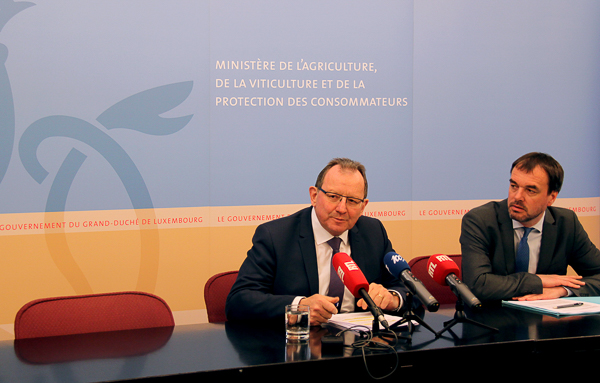
Noting the 60th anniversary of the Treaty of Rome, Minister of Agriculture, Viticulture and Consumer Protection, Fernand Etgen, affirmed Luxembourg’s commitment to the Common Agricultural Policy (CAP), during a retrospective on one of the central pillars of European integration, notwithstanding its relatively late establishment in 1962.
In the post-war period, and after years of famine, the founding members states needed to revive their economies, while ensuring an adequate food supply and that farmers received a proper income, and so Article 33 of the European Community Treaty set up the objectives for CAP.
In the main, these were to increase productivity through technical progress and optimum utilisation of production resources, including labour, while ensuring a fair standard of living for the agricultural community. To achieve this, they needed to stabilise markets, and provide security along the value chain as well as ensure reasonable prices for consumers.
In its 55 years, the CAP has evolved enormously though, the Minister suggests, through a series of crises and respondent reforms, it has perhaps become a victim of its own success. Nonetheless, the ministry said, it continues to fulfil its primary objectives and its foundations have remained unchanged.
"You have to realise that without the CAP there would simply be no more family farms in the Grand Duchy with all the consequences that would have on the environment and the countryside,” said the minister, adding “Without CAP, the European agricultural markets would dissipate amid the increasing globalisation. Without PAC, our foodstuffs would not meet such high standards in terms of quality and safety."
The minister said that agricultural policy provides farmers with the means to face new challenges and better respond to changes in public attitudes both In terms of food security, animal welfare and more environmentally friendly farming practices.
"It is essential to strengthen the position of farmers in the production and consumption chain in order to build bonds of solidarity and trust with citizens."
In this context, Minister Etgen stressed the need to modernise and simplify regulations in order to re-legitimise the CAP. He invited all interested parties to participate in the public consultation launched by the European Commission on the future of the CAP. Especially in Luxembourg, the conclusions of the Rifkin study constitute a good basis for discussion for the Zukunftsdësch, which aims to define the future direction of agricultural policy.
For Minister Etgen, it is clear that member states need a strong CAP in a common European project that requires a budget commensurate with these ambitions. National withdrawals have no place in European integration and the CAP is a good example: for nearly 60 years the common agricultural policy has been a success.
"It is with a resolutely optimistic and confident look that I look to the future. In my opinion, a CAP-Exit is by no means an alternative!"