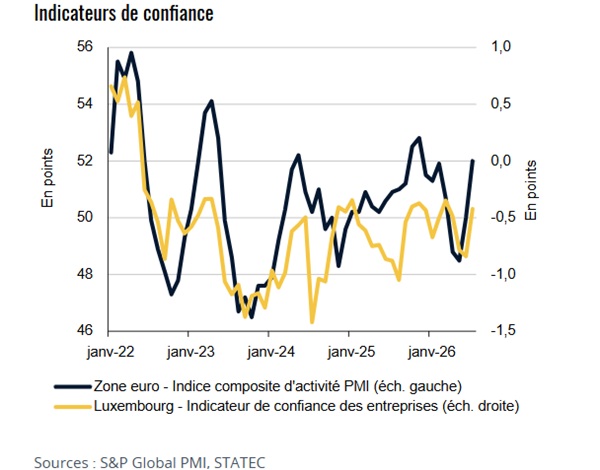
 Business confidence 2026 Q2;
Credit: Statec
Business confidence 2026 Q2;
Credit: Statec
According to a report published on Tuesday 25 August 2026 by STATEC, Luxembvourg's statistics office, the international turbulence has been clearly reflected in business surveys over the past few months, both in the Eurozone and in Luxembourg; however, activity in the Eurozone held up well in the second quarter and has shown moderate but steady growth over the past few quarters.
Economic activity in the eurozone held up well in the second quarter of 2026, with GDP growing by 0.4% quarter-on-quarter. This result was better than expected (the initial consensus among analysts had forecast a 0.2% increase), considering the negative signals represented by the energy inflation shock linked to the conflict in the Middle East and the deterioration in business surveys observed during the spring. Activity rebounded in France, rising by 0.2% (after a 0.1% decline in Q1), supported by a rebound in aerospace and capital goods exports. A similar increase was recorded in Germany, also driven primarily by exports and, to a lesser extent, by household consumption, while investment declined. Spain (+0.7%) maintained a similar pace of expansion to that observed on average over the previous four quarters, remaining a major contributor to overall growth. Ireland, whose GDP growth is particularly volatile, has significantly influenced the euro area's GDP figures in recent quarters. Unlike the first quarter, when it weighed heavily on euro area growth, this time it made a positive contribution. Excluding Ireland, the euro area's GDP grew by 0.3% over the quarter, a result identical to that of the three preceding quarters. Beyond the volatility linked to Ireland's performance, the underlying trend in the euro area is therefore one of moderate growth (with notable differences between countries), but relatively steady growth.
This picture contrasts with the significant fluctuations observed in business and consumer surveys over the same period. The opinions of economic actors clearly reflected the upheavals of a destabilised international context, marked in particular in recent months by the consequences of the war in Iran (and especially the rise in energy prices). Despite a period of relative calm in June and July following the signing of a memorandum of understanding between the United States and Iran, tensions have since risen sharply again between the two sides. The number of ships transiting the Strait of Hormuz, which had temporarily increased, has returned to its lowest level, and there is currently no concrete indication of an imminent resolution.
And what about Luxembourg?
In Luxembourg, business and consumer confidence indicators, which, as in the Eurozone, had declined during the spring, are recovering slightly at the start of summer, but it would be risky to bet on the beginning of a turnaround.
Luxembourg's GDP figures for the second quarter are not yet available, but several points are emerging from the available short-term indicators. Rather positive signs are emerging regarding household consumption, with retail sales volume up compared to the first quarter (excluding fuel outlets and mail order) and a significant increase in new car registrations (after near stagnation in Q1). Net UCITS fund issuances remained relatively high, in a stock market environment that remains dynamic. Industrial production increased for the 3rd consecutive month in May and construction production continued to follow the slightly upward trend that began at the end of 2025. In the non-financial services sector, production results (turnover in volume), available for April and May, are mixed: rather better than in the 1st quarter in the transport and warehousing, Horeca and real estate sectors, but down in the information and communication services and business services sectors.