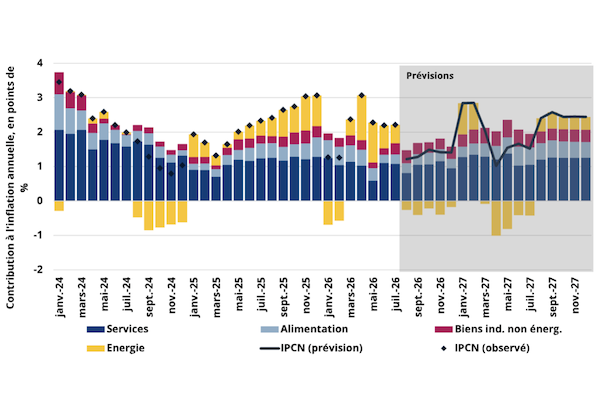
 Annual inflation rate and contributions;
Credit: STATEC
Annual inflation rate and contributions;
Credit: STATEC
On Wednesday 5 August 2026, Luxembourg's statistics institute, STATEC, revised its inflation forecast to 1.8% for 2026 and 2.1% for 2027, citing lower-than-expected prices, measures introduced under the Resilienzpak and updated international assumptions.
STATEC reported that the de-escalation of the conflict in the Middle East in June led to a rapid decline in energy prices, although oil and gas prices rose again in July. With seven months of 2026 now completed, observed prices have remained below the assumptions used in the institute's May forecast. STATEC also noted that measures introduced under the Resilienzpak are expected to slow inflation this year.
According to the institute, the next wage indexation would occur in the third quarter of 2027 under both the central and low scenarios. However, a renewed surge in energy prices similar to that assumed in the high scenario would trigger an additional indexation as early as the fourth quarter of 2026.
Energy shock remains contained
STATEC noted that the impact of higher energy prices has so far remained limited. While energy prices in the euro area were still around 10% higher year-on-year in July, no significant spillover into other prices has yet been observed. In Luxembourg, annual inflation stood at 2.2% in July, compared with 2.9% in the euro area, while food inflation has stabilised at around 1.5% since June.
As a result, STATEC revised its 2026 forecast down by 0.7 percentage points from the 2.5% projected in May. The institute attributed 0.3 percentage points of the revision to lower-than-expected price developments between May and July, 0.3 percentage points to the Resilienzpak measures and 0.1 percentage points to updated international assumptions prepared by Oxford Economics.
Resilienzpak measures
STATEC said the Resilienzpak, adopted under the Tripartite agreement, is expected to reduce overall inflation by 0.3 percentage points in 2026. The measures include reductions in fuel, heating oil, electricity and natural gas prices and are intended to protect household purchasing power and business competitiveness.
Because these measures expire at the end of 2026, STATEC expects their withdrawal to increase inflation in 2027, bringing next year's forecast to 2.1%.
Oil prices and remaining risks
The institute's baseline scenario assumes an average Brent crude oil price of around $83 per barrel in 2026, down from almost $90 in the May forecast. Nevertheless, STATEC expects prices to remain above their pre-conflict levels through 2027.
The institute identified food prices and natural gas as the main sources of uncertainty for next year. It pointed to higher fertiliser prices, heatwaves, the expected development of an El Niño event and lower-than-average European gas storage levels as factors that could place further upward pressure on inflation.
Alternative scenarios
STATEC also presented two alternative scenarios.
In the high scenario, based on a prolonged conflict and continued disruption to shipping through the Strait of Hormuz, inflation in Luxembourg would reach 2.9% in 2026 and 3.2% in 2027, with wage indexation taking place in the fourth quarter of 2026 and again in the third quarter of 2027.
In the low scenario, assuming a faster easing of energy markets, inflation would reach 1.7% in 2026 and 1.8% in 2027, with the next wage indexation remaining in the third quarter of 2027.
The full inflation forecast and alternative scenarios are available on STATEC's website.