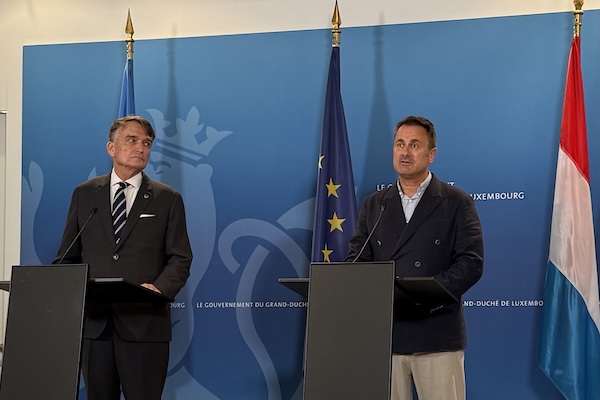
 (L-R) Christian Saunders, Commissioner-General of the UNRWA; Xavier Bettel, Luxembourg's Deputy Prime Minister, Minister for Foreign Affairs and Foreign Trade and Minister for Development Cooperation and Humanitarian Affairs;
Credit: Ievgenii Karanov
(L-R) Christian Saunders, Commissioner-General of the UNRWA; Xavier Bettel, Luxembourg's Deputy Prime Minister, Minister for Foreign Affairs and Foreign Trade and Minister for Development Cooperation and Humanitarian Affairs;
Credit: Ievgenii Karanov
On Thursday 16 July 2026, Luxembourg's Deputy Prime Minister, Minister for Foreign Affairs and Foreign Trade and Minister for Development Cooperation and Humanitarian Affairs, Xavier Bettel, held a joint press conference with Christian Saunders, Commissioner-General of the United Nations Relief and Works Agency for Palestine Refugees in the Near East (UNRWA), in Luxembourg-Ville.
The press conference provided an opportunity to review UNRWA's humanitarian work and Luxembourg's continued support for the agency, particularly under the 2025-2027 Strategic Partnership.
Minister Bettel reaffirmed Luxembourg's political and financial commitment to UNRWA, noting that the Grand Duchy had continued supporting the agency even after several countries suspended their funding. "When we visited the region, we saw that there was no viable alternative," he said, adding that "Luxembourg remains a reliable and committed partner. We want to continue the projects we are carrying out together because they serve both UNRWA and the Palestinian people."
He also highlighted the agency's reform efforts, noting that around 80% of the recommendations made in the independent Colonna review had been implemented by March 2026, demonstrating UNRWA's commitment to neutrality and accountability.
Referring to Luxembourg's recognition of the State of Palestine in 2025, Xavier Bettel said the upcoming United Nations meetings should also assess the commitments made by the Palestinian Authority and whether tangible progress had been achieved on the ground. He reiterated Luxembourg's support for a two-state solution, saying that lasting peace in Palestine would also contribute to Israel's security.
Christian Saunders outlined UNRWA's current operations and the scale of the humanitarian assistance the agency continues to provide across the region. He noted that UNRWA, established in 1949, now serves around six million registered Palestine refugees, with approximately 2.6 million people currently receiving assistance across Gaza, the West Bank, Jordan, Lebanon and Syria.
Referring to the situation in Gaza, he said UNRWA continues to employ 11,000 staff in the territory, providing assistance to around two million Palestinians. He noted that the agency carries out between 12,000 and 14,000 medical consultations every day and provides online education for 300,000 children. In addition, more than 60,000 children attend classes in tents and prefabricated classrooms. UNRWA also supplies water and sanitation services to around 1.5 million people and removes approximately 20,000 tonnes of waste each month, despite operational restrictions imposed by Israel.
Christian Saunders also addressed UNRWA's neutrality reforms, noting that the agency had already implemented 40 of the 50 recommendations made in the independent Colonna review, with a further five due to be completed by the end of the year. He stressed that UNRWA operates the United Nations' most comprehensive neutrality programme and continuously monitors teaching materials and staff compliance with UN standards.
"Nobody has the infrastructure, the experience, the skillset or the staff to be able to do what we do now on behalf of Palestine refugees," Christian Saunders said. "That doesn't mean UNRWA needs to exist forever. As soon as there is a recognised Palestinian administration able to assume these responsibilities, UNRWA should hand over those services. Until then, we have a mandate and an obligation to ensure that Palestine refugees have access to these critical services."
Responding to a question about criticism from Luxembourg politicians who have accused UNRWA of being infiltrated by Hamas and alleged that Luxembourg's financial support benefits terrorism, Minister Bettel rejected the claims. He said Luxembourg had seen first-hand the projects it supports and continued to trust the agency. "To blame the whole organisation is really unacceptable," he said. "I trust UNRWA, and I will continue to trust UNRWA as long as there is no one able to replace it."
Christian Saunders also dismissed the allegations, describing them as "a smear campaign with a political end." He stressed that UNRWA acts decisively whenever staff misconduct is identified, while all employees are regularly screened, trained and required to comply with UN standards. He added that Israel receives the names of all UNRWA staff twice a year for security screening and "has the opportunity to raise concerns if it believes any staff member has links to a militant group or has committed a criminal act."