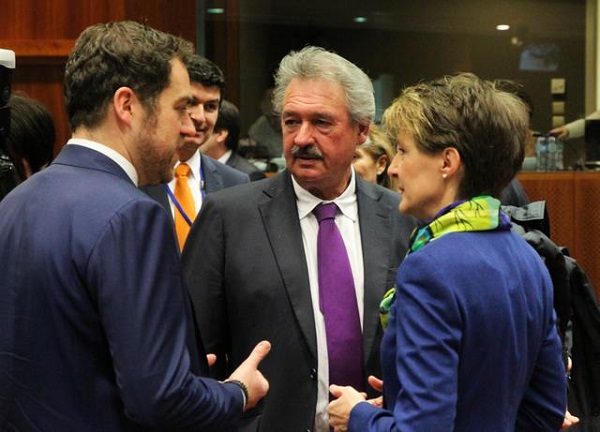
An amendment to the Schengen Borders Code discussed on Thursday at the Justice and Home Affairs (JHA) Council of the European Union will entail the compulsory verification of EU citizens' data when such individuals reach an external border crossing.
The Council, held in Brussels and attended by Luxembourg's Minister of Foreign and European Affairs and Minister for Immigration and Asylum, Jean Asselborn, managed to determine a general approach on the regulation as regards the strengthening of checks on the relevant databases at external borders. Following the December 2015 proposal of the European Commission, the Dutch Presidency now has a negotiating mandate to begin a trialogue with the European Parliament.
The Council agreement was preceded by a debate, during which Minister Asselborn stated that "our collective security, that of each citizen, depends on the weakest link in chain of control of Schengen States", claiming it was now important to quickly proceed with negotiations.
Ministers then heard the state of play on negotiations concerning the proposed creation of a European Border and Coast Guard Agency, which would seek to pool resources from Frotnex and EU Member States as a means of monitoring migration flows, identifying weaknesses and taking the necessary measures in the event that an EU external border is experiencing pressure. The ministers present agreed to an ambitious bargaining timeline.
The JHA Council gave an update on the implementation of existing migration measures, as well as on the situation of the Western Balkans route, in the wake of the February 2016 European Council and ahead of the next meeting of Heads of State and Government with Turkey.
Speaking to the JHA Council, Minister Asselborn appealed for a common European response to the migration crisis, calling on European partners to invest all possible resources in the deployment of Frontex, the European Asylum Support Office (EASO), the United Nations Refugee Agency (UNHCR) and the International Office for Migration (IOM), as a means of providing a support mechanism for Greece and Italy. He cited the procedure initiated under Artuckes 19 and 26 of the Schengen Borders Code not as a punitive process but rather a logical step for support and coordination. The Minister further claimed that Member States and third countries needed to better collaborate, to prevent the emergence of alternative routes.
Lastly, the Council allowed Ministers to hold an exchange of views on cooperation between the EU and Turkey, attended by Turkish Deputy Interior Minister. According to Minister Asselborn, "it is important to continue and to strengthen the partnership with Turkey, which is an integral part of an effective solution in the long term."
Photo by MAEE (L-R: Jean Asselborn, Minister for Foreign Affairs, Minister for Immigration and Asylum of Luxembourg; Klaas Dijkhoff, Secretary of State for Security and Justice of the Netherlands; Simonetta Sommaruga, Federal Minister of Justice and Police of Switzerland)