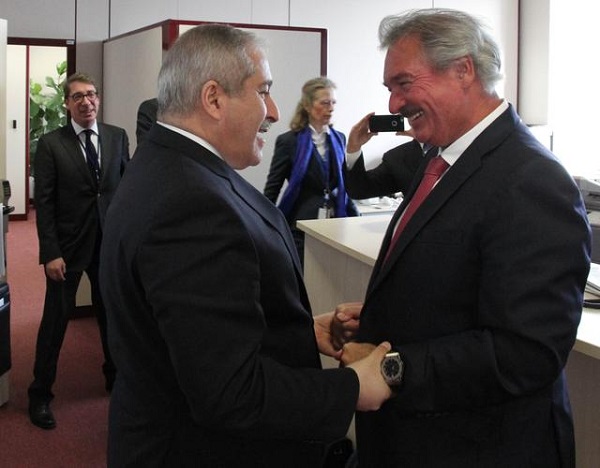
At a Foreign Affairs Council (FAC) meeting held on Monday 18 January 2016 in Brussels, Luxembourg Minister of Foreign and European Affairs, Jean Asselborn, denounced military attempts to solve the conflict in Syria, stating that moderate opposition parties should be supported instead.
The Foreign Affairs Council presented an opportunity for High Representative of the Union for Foreign Affairs and Security Policy, Federica Mogherini, to inform the ministers present of her observations on the situation in Venezuela, before talk turned to regional issues in the Middle East, particularly regarding Syria.
Ministers exchanged views on how the European Union could support the peace process under the aegis of the United Nations and the 2254 resolution of the Security Council. According to Jean Asselborn, "the last four years have shown that there can be no military solution to the conflict" and that a long-term political solution would require support to "moderate actors of the opposition" and the "non-jihadist opposition speaking with one voice."
Minister Asselborn's words were reflective of a previous speech he had made at the 2015 Organisation for Security and Co-Operation in Europe (OSCE) Mediterranean Conference in Jordan, where he claimed that "external forces influencing the warring parties should be, instead of financially supporting the war, working for a political solution between the moderates" in what appeared to be a criticism of Russia's support of al-Assad.
The FAC then discussed Iraq particularly with regards to the implementation of political and economic reforms which are expected to lead to a process of national reconciliation. The Luxembourg Foreign Minister stressed the importance of "full EU support of the inclusive government of Haidar al-Abadi, which is engaged in a path towards reform and national dialogue." He then expressed hope for the process but claimed that it was not gaining in momentum stating: "Important reforms have been initiated, but they are progressing very slowly."
In the presence of their Jordanian counterpart, Nasser Judeh, the Foreign Ministers then discussed political cooperation between the EU and Jordan and addressed relations between Iran and Saudi Arabia. The ministers further exchanged views on the Israeli-Palestinian issue.
Talks then examined the situation in Ukraine, with particular focus paid to the role that the EU could play in the country's reform process. "We must stress the importance of continuing along this path, particularly for reforms in the Minsk process and the Association and Free Trade Agreement, now that the Free Trade Zone has tentatively entered into force," remarked Minister Asselborn.
On the sidelines of the Council meeting, the Luxembourg Minister participated in an EU-Ukraine meeting where the Union's relations with the country were examined in depth, particularls in the areas of visa liberalisation, the Deep and Comprehensive Free Trade Area (DCFTA) and the resolution of the conflict in eastern Ukraine.
Photo by MAEE (Luxembourg Minister of Foreign and European Affairs, Jean Asselborn (right) with Jordanian counterpart Nasser Judeh)