The Fondation IDEA has just published a Working paper on the (hot) topic of start-ups.
Written by Michel-Edouard RUBEN, it is full of data to demystify the bias and its ends up with three recommendations to maintain the dynamic business creation observed in the country, and to encourage the growth of medium-sized and growing enterprises.
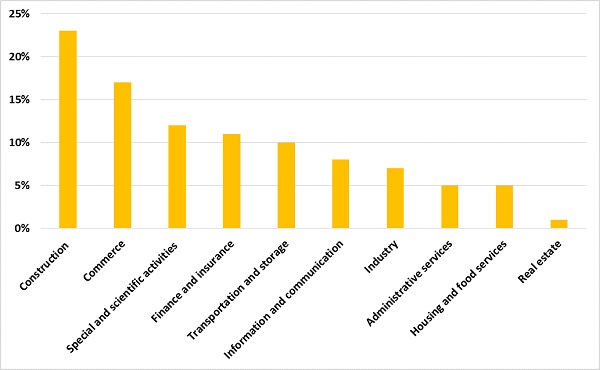
Since a strict definition of the concept of “start-up” does not exist, a start-up can (trivially) be considered as a young innovative company. It is therefore an abuse of perception to consider that a start-up is limited to companies in the information and communication technologies (ICT) sector, which represent only 8% of business creation and of High Growth and Innovative SME.
The proportion of innovative firms in Luxembourg being 66% - where business creation is generally well-oriented – any new company is potentially a start-up.
Recent OECD researches have shown that, contrary to a widespread view, it is not so much SMEs that fuel the process of creative destruction needed to renew productive tissue, than a limited number of young growth firms. Age would thus prevail over size: “not small, but new is beautiful”. Therefore, more than the small business act (regularly mentioned in Europe), one should think of setting up a “young business act”. Luxembourg has a dense ecosystem with institutions and aid schemes for business creation which are all assets to support a young business act.
This working document argues that this ecosystem – which needs to be constantly monitored for overall coherence – could be improved through, inter alia, three interdependent areas, with the aim of maintaining the positive dynamics of business creation observed in the country, and to encourage the growth of medium-sized and growing enterprises:
1. The multiplication of business angels and the introduction of innovation checks
Residents in Luxembourg – which have on average a large financial base - invest very often in real estate, which tends to crowd out investment in other asset classes (including equity investments in companies). Beyond the necessary rationalization of tax concessions to housing in particular, and non-risky savings in general, it seems necessary to provide the Grand Duchy with a new framework favorable to business angels in order to drain the abundant savings towards the financing of promising start-ups. Tax incentives for movable investment (whether the “Rau Act” repealed in 2005 or the unknown tax credit for venture capital investment ) did not drive investment capacity of Luxembourg residents to local businesses, the new framework in particular should ensure that the errors (notably administrative burdens) that prevented the success of previous initiatives are not made. Employers and the Government could also modify their objective function (bias in favor of the creation of new enterprises) and argue that being an entrepreneur does not necessarily mean creating a business but also investing in and supporting a company and even buying back an existing business at a time when hundreds of companies will have to “change hands” with the aging of the executive population.
Also, since there is a path dependency in terms of R&D and innovation , the Luxembourg arsenal of public aid to private R&D could be increased by innovation checks for young companies. Following the Swiss model , it would be necessary to create a grant in the form of a check valid for a given period (for example 12 months), neither transferable nor convertible in cash, to cover the services of partners “eligible” to the scheme (Research institutions, e-commerce site developers, marketing strategy consultants, accountants, etc.) to encourage young companies to “innovate” and foster their growth.
2. A preferential tax system for young companies
In Luxembourg, as in 30% of OECD countries , the taxation of corporate profits is differentiated according to the amount of taxable profits.
The effectiveness of this differentiation, generally presented as support to SMEs, is however increasingly criticized in the economic literature. The relevance of such a differentiation would be debatable because, contrarily to the aim of household taxation, the objective of a redistribution between firms according to their size and based on the taxation of profits is not self-evident. The United Kingdom, having considered that it did not fully fulfill its objectives, has thus chosen to bring closer reduced and normal rates. In the context of future tax reforms, the normal rate and the reduced rate could be reconciled or even combined (like in the United Kingdom), and following Ireland, Singapore and India, it could be decided that young companies (under 3 years old) will be totally exempted from corporation tax (“IRC”, “ICC”, “IF”). This should enable start-ups to strengthen their capital stock, hire, and invest, and send a strong signal to start-uppers around the world.
3. Entrepreneurship or “hedged” and “socially responsible” entrepreneurial risk
Luxembourgish labor and social protection legislation created by and for a plant and employees economy does not guarantee the same rights between employees and self-employed persons (entrepreneurs). Since entrepreneurial activity is a risky one, promoting it (in order to encourage risk-taking and creation of high growth start-ups) implies to bridge the gap between the legal systems of labor and social security of the employees and the self-employed. Concretely, the business creator should / could be granted the right to medical visits, integrate the system of statutory holidays, or have the same rights to unemployment benefits as an employee dismissed for economic reasons (if he fails in good faith).
Established enterprises should / could be “encouraged” to stimulate entrepreneurship (beyond the incubators they house). Thus, “aid to entrepreneurship” (in the form of investments in funds dedicated to investing in young companies in the country, loans or capital contributions for spin from former employees, taking over the social contributions of a former employee who “tries” the entrepreneurial adventure, extraordinary / special leave for entrepreneurial reasons, etc.) could be included in the evaluation by INDR of corporate CSR policies.
Nevertheless, because “the bulk” of economic activity in Luxembourg (as in all OECD countries) is actually carried by a limited number of companies, Luxembourg’s ambition to be a start-up nation must not obscure the entrepreneurial function of established firms, and must be based on an optimal collaboration environment between old and new companies.
For the full study in French, see www.fondation-idea.lu/2017/07/05/document-de-travail-n7-start-up-nation-vers-young-business-act