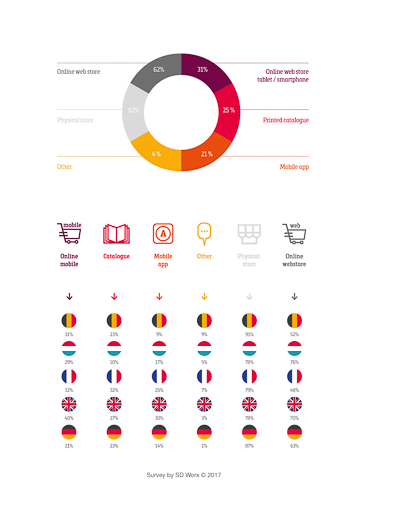
Two thirds of retailers have already embraced e-commerce according to a survey of almost 500 retailers in the UK, Belgium, France, Germany and the Netherlands conducted by HR service provider, SD Worx.
The integration of digital sales platforms has been quite recent though, with most adopting e-commerce in the last five or six years a shift that seems to have become inexorable as 60% are convinced that those don’t invest will ultimately run into difficulties.
E-commerce’s strong growth has brought challenges for retailers though, who seem to have been slower to adapt and adopt than their customers, the survey’s authors said.
Their sample revealed that 62% of retailers have an online shop, with clothes and shoe outlets as the pioneers, while DIY retailers were found to barely make use of e-commerce at all.
The Netherlands has been blazing the trail compared to Belgium, France, Britain and Germany, with more than 76% of Dutch retailers boasting an online shop. Of the countries surveyed, France scored the lowest, with 48%.
However, the authors felt that online shops remain insufficiently mobile with only 31% specifically adapted for smartphones.
Only one in five retailers have developed a dedicated app for their online shop, though that conceals significant differences between the countries. Belgian retailers are clearly in the minority here with only 9%, while the British, among whom 30% of retailers have a dedicated app, take the lead.
The report’s authors said that retailers are seeing a positive impact on sales with 70% expecting further growth driven by e-commerce.
However, while the traditional retail sector might feel increased competition from large e-commerce stores, shopping in a physical store remains important for customers. The majority of retailers are convinced that the combination of a physical store with an online presence is crucial to remaining successful in the future.
This may help to alleviate concerns that some have over the impact on employment. SD Worx retail expert, Peter Van Ostaeyen, doesn’t believe that a thriving e-commerce industry will have detrimental effects on employment in the sector.
“Employment might decline due to e-commerce in certain segments, such as small retail outlets. In contrast, other segments, such as new online chains and flagship stores, will actually require more people. We’re therefore talking about a shift in employment.
“Don’t forget that e-commerce also creates a number of jobs in logistics, such as warehousing and distribution. Retailers that bet on an omni-channel strategy and merge online and offline customer experience will triumph. Physical and online stores complement each other and intensify customer experience. Our sample indicates that only 60% of the retailers surveyed apply such an omni-channel strategy. So there’s still a long way to go,” he said.