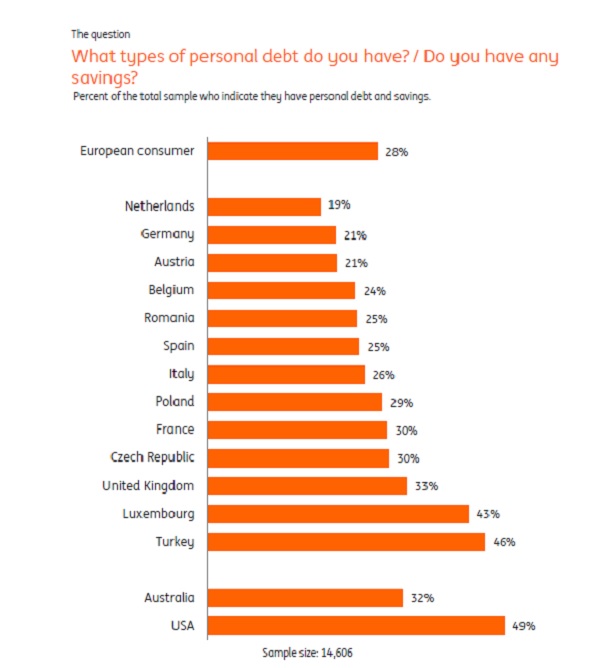
Despite results showing that 42% of Grand Duchy residents are either somewhat or very satisfied with their bank savings, 55% admit to having personal debt.
This score puts Luxembourg in the top 3 for countries with the most debt, along with Romania and Turkey. "Personal debt" refers to dues such as a bank overdraft, credit card debt, student loans, personal bank loans, and money lent to friends or family. It does not include mortgages.
Taking a closer look at the various types of debt in Luxembourg, it would seem that the main source of resident debt is personal loans at 27%, versus 8% for credit card debt and 11% for bank overdrafts.
Compared with other neighbouring countries such as France, Belgium and Germany, Luxembourg has the highest number of residents with a personal loan, at 27%. They are also the most at ease – even very at ease – with their level of debt (12% + 24% = 36%).
Low interest rates are no doubt a contributing factor to this debt. It would appear this incentivises 14% of Luxembourg residents to take out loans, versus 8% in other neighbouring countries.
Savings
ING’s sixth annual savings survey shows people are more comfortable than in years past with their level of savings, in all countries but the Netherlands. Despite this, though, the study underlines that personal finances are fragile. Across Europe, 29% say they have no savings whatsoever. Of those in Europe who have savings, 36% have the equivalent of three months’ take-home pay or less.
Reluctance to invest
Despite this situation, few indicate a move towards investments, rather than savings. Four percent have bought real estate and 17% some other investment, such as shares or bonds. Many simply do not have enough money to invest: the low level of savings compared with income noted earlier indicates this. However other factors are also at play – such as risk perceptions and the natural fear of loss. More than half of those surveyed indicate they are unlikely to invest even 10% of their savings into financial products or other assets – even if in a situation where they can do so. Only 17% suggest they may be likely to invest in shares. Overall, many people across all 15 countries wish to avoid financial risk.
The survey covered 15 countries, with around 1,000 respondents surveyed in each (except Luxembourg, with 500); the total number of respondents was 14,606.