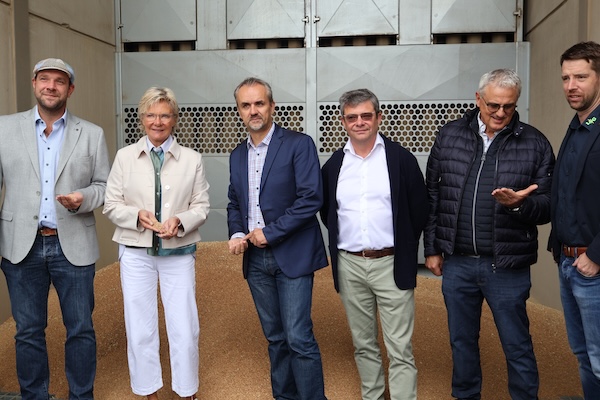
 (L-R) Christian Hahn, Chamber of Agriculture; Martine Hansen, Minister; Serge Turmes, De Verband; Frédéric Baijot, Moulins de Kleinbettingen; Günter Mertes, BAKO Bauere Koperativ; Steve Turmes, LSG Lëtzebuerger Saatbaugenossenschaft;
Credit: MA
(L-R) Christian Hahn, Chamber of Agriculture; Martine Hansen, Minister; Serge Turmes, De Verband; Frédéric Baijot, Moulins de Kleinbettingen; Günter Mertes, BAKO Bauere Koperativ; Steve Turmes, LSG Lëtzebuerger Saatbaugenossenschaft;
Credit: MA
On Wednesday 26 August 2026, Luxembourg’s Minister of Agriculture, Food and Viticulture Martine Hansen met representatives of the cereal sector from De Verband Group / Versis, Bauere Koperativ (BAKO), Moulins de Kleinbettingen and Lëtzebuerger Saatbaugenossenschaft (LSG) at De Verband's premises in Colmar-Berg to take stock of this year's harvest.
According to the Luxembourg's Ministry of Agriculture, Food and Viticulture this year's cereal and forage harvests have been significantly affected by heatwaves and drought, with the country's cereal harvest ending historically early in August.
Winter crops were sown under normal conditions last autumn and generally survived the winter well. Heavy rainfall in February slightly delayed initial maintenance work and the sowing of summer cereals. Crops subsequently developed well during the dry months, with relatively low disease pressure, before heatwaves from mid-May and June, combined with significant rainfall deficits, accelerated ripening.
Representatives of the cereal sector reported satisfactory winter cereal yields, albeit slightly below the long-term average. Summer cereals suffered considerably greater losses in both yield and quality due to drought, they said.
The harvest began with winter barley around Luxembourg's National Day. Rainfall deficits of up to 100 mm in June and July resulted in the cereal harvest being completed nationwide by early August, which is historically early for Luxembourg.
Despite cereal prices improving by around 10-15% compared with last year, Serge Turmes, Director of De Verband Group / Versis, said cereal cultivation was not economically viable this year. The ongoing crisis in the Middle East has pushed up fertiliser and fuel costs, while the recovery in cereal prices from previously low levels has not been sufficient to compensate for higher production costs and lower yields.
Winter rapeseed provided a more positive picture, with yields largely unaffected by the drought and selling prices partly influenced by oil prices. Niche crops such as spelt and oats also performed relatively well. Günter Mertes, Managing Director of BAKO, reported “good yields” and “very good quality” for winter oats, while the market is developing positively. Spelt prices have also remained relatively stable in recent years.
For "produit du terroir" labelled bread wheat, the harvest amounted to more than 11,000 tonnes, down 9% compared with last year and significantly below earlier expectations, according to Frédéric Baijot, Managing Director of Moulins de Kleinbettingen. However, the harvested wheat was reported to be of particularly high quality for processing into baked goods.
The situation was more critical for forage production. Around three-quarters of Luxembourg's agricultural land is used to produce basic feed for ruminants. Two average cuts of good quality were harvested from grassland, but the third cut almost completely failed. Farmers have already been feeding livestock with reserves originally intended for winter for several weeks. Rainfall in the coming weeks will determine the size of the final autumn cut.
Conditions for silage maize vary considerably, ranging from good crops to severely drought-damaged fields that have already been harvested. According to the ministry, local rainfall and farms' ability to adapt have played a decisive role this year. Some farms still have feed reserves following two productive years, although Minister Hansen stressed that further rainfall is urgently needed.
A similar situation has been reported in the potato sector. Following particularly large harvests last year, conditions vary considerably between fields this year and autumn yields are expected to be limited.
Minister Hansen stressed: "Agriculture must adapt to climate change. We are looking with concern at the extreme weather fluctuations, geopolitical instability, volatile producer prices and increased production costs. For our farmers, it is vital to diversify their production activities, plan ahead economically and take out insurance against crop losses, for which the Ministry of Agriculture, Food and Viticulture provides a 65% subsidy. Among the insured crops and areas, the greatest damage has been recorded in cereals (approximately 5,600 ha) and maize (approximately 6,000 ha). Drought damage to grassland is also estimated to be very high, although a precise figure cannot yet be given."