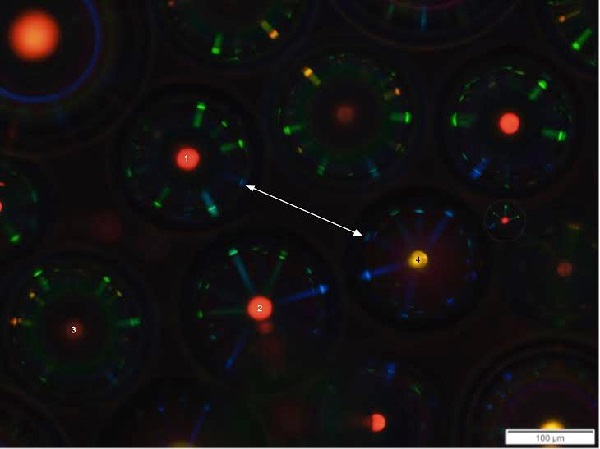
A European collaboration involving researchers from the Universities of Luxembourg, Ljubljana and Vienna has seen a new method developed to produce unique reflecting patterns that can be applied on valuable objects to fight against counterfeiting.
The ability to authenticate objects presents a veritable personal, societal and national goldmine in the modern-day globalised and inter-connected world, enabling buyers and sellers to be reassured with proof that the goods the client is receiving match the price that they have paid. The process holds utmost importance in businesses faced with the threat of counterfeit phones, SIM cards, debit cards and similar pieces of equipment. The object's holder can be authenticated with the use of passports, ID cards and badges or fingerprint or iris recognition.
However, such strategies are not 100% effective as objects can be forged, cards can be cloned and even fingerprints stolen. The latter has recently made headlines, revealing an approach which presents a long-term, indefinite risk.
A more secure solution therefore would be unclonable, non-biometric physical tokens that are easily available but individually unique, as well as inexpensive to produce. This consideration has led to the concept of Physical Unclonable Functions (PUFs) - objects that give a unique response to physical inputs of different kinds.
The PUFs can scatter light in unpredictable directions or sparkle with a variety of colours, react with unknown delays or start up in random states when switched on. They can nowadays be found inside microchips, ensuring that the silicon components come from an authorised factory. Meanwhile optical PUFs are more rare but generate a response to light input that can be captured by a visual recording device to authenticate the value.
Dr. Gabriele Lenzini of the Interdisciplinary Center for Security and Trust (SnT) and Prof. Jan Lagerwall of the Physics & Materials Science Research Unit (PhyMS) of the University of Luxembourg have joined forces to develop an entirely new type of PUF, based on the peculiar optics of spheres of a so-called cholesteric liquid crystal. The periodic structure of this liquid crystal means that the spheres are able to reflect specific colours in a similar vein to the wings of butterflies or peacocks.
With the support and expertise of photonics experts Professor Irena Drevensek-Olenik (University of Ljubljana) and Professor Romano Rupp (University of Vienna), the team carried out a detailed analysis of the optics of a large number of such spheres, and in so doind discovered that the spheres communicate with each other in an unexpected fashion, creating a colourful pattern that can be tuned dynamically according to the manner in which the spheres are illuminated. Due to the random arrangement which is made possible with these different types of liquid crystal spheres, the generated patterns of an owner are equally random and make it impossible for the token and its related set of patterns to be copied.
In their paper, published in science journal "Scientific Reports", Geng et al. also introduced a technique for guaranteeing that the spheres are robust enough to make them easy to handle when a PUF token is being prepared, yet remain delicate to ensure that any attempts to tamper with them would result in the spheres being broken and the token invalidated.
The researchers have also developed a new method of annealing the spheres to drastically redue production time through a microfluidic process at low cost. This new category of PUF can be used in a variety of security applications to help solve a significant problem in modern society.
Photo by University of Luxembourg