On Tuesday 3 May 2016, the Luxembourg Institute of Health (LIH) published the 2015 National Drug Report examining the state of drugs and substance abuse in the Grand Duchy.
According to the report, the trends in Luxembourg broadly reflect those observed within the EU, with the stabilisation of the use of illegal drugs. Specifically, the number of problem drug users indexed by national institutions has stabilised in the past decade. In proportion to the growth of the national popultation, prevalence has even slightly fallen.
The Minister of Health commented that the number of patients in acute treatment in hospital, which has decreased for the past several years, has stabilised, whilst outpatient specialised and alternative care has gained traction, providing for the best national substitution coverage within the EU. Users of illegal drugs are also entering treatment at an earlier stafe, which could be due to a support offering that has been diversified in recent years.
"Since the national "Drugs and Addiction 2005-2009" action plan, more and more users of illicit drugs are benefitting from the offers of risk reduction (such as for example Fixerstuff) or outpatient services," explained Minister of Health, Lydia Mutsch. "This has also been accompanied by a significant drop in the last eight years of death by overdose in Luxembourg (27 cases in 2007 and 8 cases in 2014)!"
From the opening of the first supervised drug consumption room until the end of 2015, around 1,900 overdoses were managed and no overdose handled by this structure resulted in a fatality.
The average age of victims has risen steadily from 28.4 years in 1995 to 32.3 years in 2014, whilst the proportion of victims under 20 years has remained relatively stable. Meanwhile, the overall ageing population of drug users has created new needs which the Ministry of Health stated it would address by registering medical and psychosocial measures adaped to the national Drugs and Substance Abuse Plan.
"Whilst the results of the RELIS 2015 report are broadly encouraging, we should remain vigilant: the field of drugs and addiction is constantly changing," warned Lydia Mutsch. "Illegal markets and, hence, the availability and accessibility of drugs, as well as the consumption of behaviour of users, is changing rapidly."
The number, types and availability of new psychoactive substances in Europe continues to grow dur to globalisation, technological advances and the Internet. More organised distribution networks have also emerged in recent years at the national level. The expansion of these networks led to a significant increase in the availability of illegal drugs, particularly with regard to the cocaine supply. New synthetic drugs and related products (NPS, legal highs) are also on the rise.
"It is especially important to observe them closely and give ourselves adequate means to adapt permanently and quickly to the realities on the ground," the Minister advised.
The proportion of non-Luxembourgish drug traffickers was found to have remained stable in recent years. According to the report, an additional indicator of the increased availability of illicit drugs at the national level is apparent in the fact that currently almost 50% of users buy their illegal drugs exclusively in Luxembourg, against 15% in 2008.
The comments and observations made on the monitoring of phenomena linked to illicit drugs and substance abuse, through the Luxembourg Information Network on Drugs and Substance Abuse (RELIS), were integrated into the development of the strategy and national action plans in the fight against drugs and their addictions. From 2004 to 2015, the overall budget allocated by the Ministry of Health to services and programmes in the field of drugs and addiction was increased from €5.8m to €11m.
A debate on the use of illicit drugs in Luxembourg is being prepared to be launched by the Minister of Health, Lydia Mutsch, in close collaboration with the Minister of Justice, Félix Braz. The debate will draw on recent figures and findings from the UN General Assembly (UNGASS) on the global drug problem, which was held from 19 to 21 April 2016.
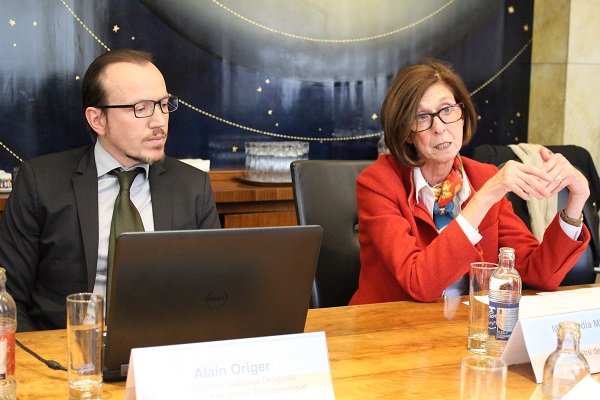
Photo by MSAN (L-R): National Drugs Coordinator, Dr. Alain Origer; Minister of Health, Lydia Mutsch