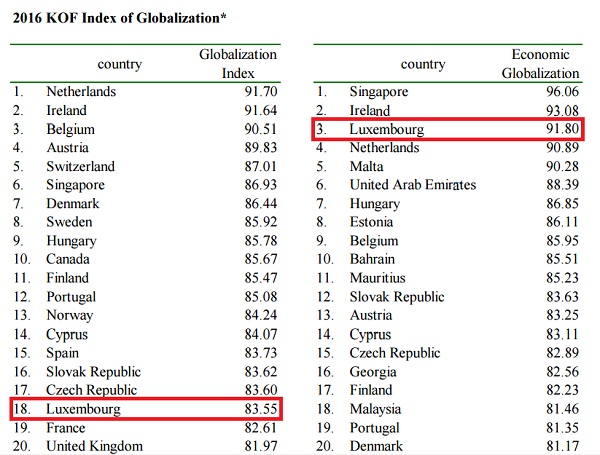
According to the KOF Globalisation Index 2016 of the KOF Swiss Economic Institute, data from 2013 placed Luxembourg in 18th place out of 207 in terms of the world's most globalised countries.
The overall Globalisation Index of the Grand Duchy came in at 83.55, placing it just ahead of the country's neighbour France (82.61) and immediately behind the Czech Republic (83.60). The Netherlands, Ireland and Belgium claimed the top three spots, at 91.70, 91.64 and 90.51, respectively, with the only non-European countries in the top 15 being Singapore (6th) and Canada (10th).
The aggregate country score was determined based on the three primary dimensions of globalisation: economic, social and political. Luxembourg unsurprisingly fared well in the former, which "refers to the extent of cross-border trade, investment and revenue flows in relation to GDP, as well as the impact of trade and capital transaction restrictions". In this category, the country was placed 3rd and its economic globalisation score of 91.80 represented an increase from 2012 when it stood at 91.26.
However, the Grand Duchy lay significantly further down the list in terms of social and political globalisation, in 30th and 60th place, respectively. From 2009 to 2013, the country's social globalisation decrease from 81.11 to 78.73, whilst political globalisation has dropped from 80.8 in 2007 to 79.44 in latest figures. The social dimension was determined through cross-border personal contacts, tourist flows and the amount of foreign residents, as well as access to various media and global imports and exports. The political component refers to "the number of foreign embassies resident in a country, the number of international organisations of which the country is a member, the number of UN peace missions in which the country has been engaged and the number of bilateral and multilateral agreements the country has concluded since 1945".
"A number of key developments determined the trend in 2013: The gradual recovery of the global economy continued," it was explained in the KOF Globalisation Index 2016. "In the USA, signs indicated an imminent normalisation of monetary policy. However, the Fed’s announcement of reduced bond purchases led to major capital outflows and currency devaluations in the emerging markets. Although the Eurozone finally came out of recession, massive public debt continued to place a strain on the economies in the crisis countries. The Middle East was dominated by the aftermath of the Arab Spring. Syria was wrecked by civil war and Egypt saw the military get back into power."
Table by KOF Swiss Economic Institute