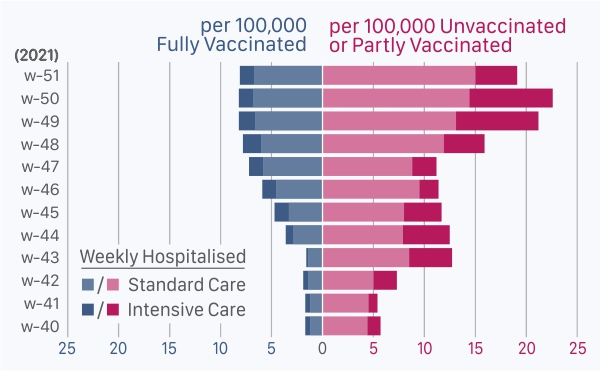
As of Wednesday 29 December 2021, Luxembourg had reached the 80% mark for fully vaccinated members of the population (residents aged 12 years or older) and, with the emergence of the highly transmissible Omicron variant, Chronicle.lu analysed the data available to understand if vaccinations are having an effect on COVID-19 hospitalisations among residents.
The main findings of the data analysis (see graph above) show three times fewer hospitalisations in standard care and five times fewer in intensive care were needed for fully vaccinated patients (per 100,000) on average over the last twelve weeks (October - December 2021) compared to unvaccinated or partly vaccinated residents (per 100,000).
Methodology
We normalised the weekly data from Luxembourg's Ministry of Health, along with the vaccination status of patients admitted to standard care or intensive care (ICU), to per 100,000 fully vaccinated or unvaccinated (including partly vaccinated) residents of the reference week: this was based on available data and was done to ensure that we could compare like-with-like data.
The 634,730 residents as of 1 January 2021 was considered as the total population.
The vaccination status of the hospitalised patients is available since week 40 (starting Monday 4 October 2021).
A total of 577 residents were hospitalised over the last twelve weeks (in total, 423 were in standard care with 154 in intensive care).
A total of 74 deaths related to COVID-19 were also reported over the same period (4 October 2021 to 26 December 2021); however, the vaccination status is not known for the deceased.
The latest report from Luxembourg's national laboratory (Laboratoire National de Santé, LNS) on SARS-CoV-2 genomic surveillance shows only five Omicron cases from the 769 samples sequenced from week 49, representing less than 1% prevalence among the variants (lineages) observed in the weekly data (sequencing ).
(Note: it is not possible to determine the variant from a positive PCR test (or even a positive antigen test). What happens with positive tests is that the samples are then sent to the LNS for detailed analysis from which they can then determine the variant and other genomic information: this additional process takes a couple of weeks, therefore the delay in reporting variants, etc.)
Due to limited number of confirmed cases of Omicron in Luxembourg to date, while the number of daily new cases are consistently increasing since November 2021, direct correlation with the highly transmissible Omicron variant and lower hospitalisation rates among the vaccinated cannot be established.
However, early scientific publications from South Africa and Scotland (not peer reviewed) show Omicron is up to two-thirds less likely to result in hospitalisation than Delta or other strains.
Luxembourg recorded 1,053 cases as on Tuesday 28 December 2021 (reported on Wednesday 29 December) with a PCR-test positivity rate of 23.43% (4,496 PCR tests), both being the highest daily recorded since the beginning of the pandemic.
The Johns Hopkins University & Medicine data show 28.61% positivity rate (7-day average) in South Africa where high community transmission is noted and the sequencing data show almost exclusively Omicron variant since November 2021.