 Credit: Ali Sahib, Chronicle.lu
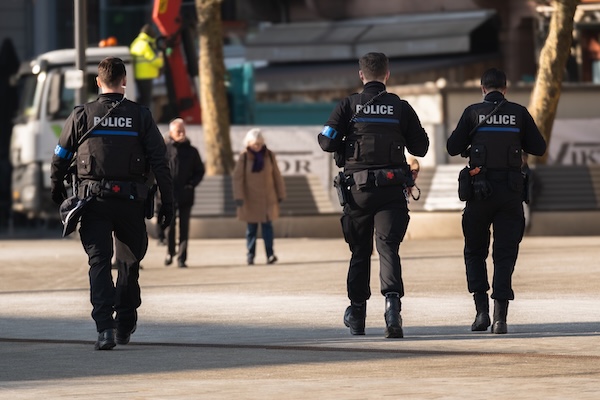
The Grand Ducal Police has announced that, as part of international police cooperation, joint patrols involving officers from the Grand Ducal Police and the Romanian Police (Poliția Română) have been operating in Luxembourg City and other municipalities since Thursday 7 May 2026.
According to the police, two Romanian officers will mainly work from the Luxembourg-Ville police station, where they will reinforce local police patrols.
The mission of these joint patrols is primarily to collect information which may be passed on to the judicial authorities in order to launch possible investigations related to human trafficking and/or organised begging. This cooperation between the two countries is planned for a renewable period of six months and is governed by the Prüm Treaty. Luxembourg’s Minister for Home Affairs, Léon Gloden, and his Romanian counterpart, Marian-Cătălin Predoiu, signed a corresponding administrative arrangement on 5 March 2026.
In practical terms, French will serve as the working language and the officers will wear their national uniforms, namely the uniform of the Poliția Română. However, they will not carry weapons. The use of force, including physical restraint by the Romanian officers, is limited to self-defence and the legitimate defence of team members or others, in accordance with Article 416 of the Luxembourg Criminal Code, said the ministry.
The two Romanian police officers have been present in Luxembourg since Monday 4 May 2026, where the Capital Regional Directorate welcomed them and introduced them to their new colleagues, premises and internal procedures before the first joint patrols began.
Also known as “Schengen III” or “Schengen Plus”, the Prüm Treaty was signed on 27 May 2005 in Prüm, Germany, by the first Schengen signatory countries: Luxembourg, Germany, France, the Netherlands and Belgium, later joined by Spain and Austria. Other member states, including Romania in 2009, later acceded to the treaty.
The treaty aims to strengthen cross-border police cooperation, particularly in combating terrorism, organised crime and illegal immigration. It also provides for the exchange of genetic data, fingerprints and personal data, the establishment of joint police patrols and other forms of intervention, including assistance during major events and joint deportation flights.