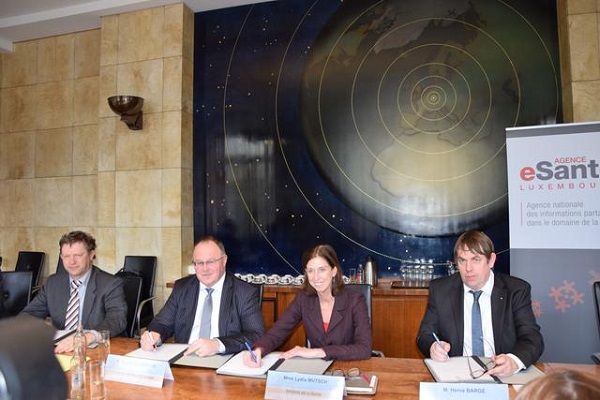
On Friday 26 February 2016, the Luxembourg State, the Caisse national de Sante and the Agence eSanté signed a new multi-year and multi-faceted shared objectives and resources contract outlining the main expectations for the Agence eSanté until 2018 and the financial means made available to achieve these.
The contract signed Friday will replace the one originally developed for the period 2013-2015, during which a national interoperability strategy was developed for health information systems; the eHealth Platform and its services were designed and implemented; and the shared care record (DSP) was launched at the suggestion of the Commission nationale pour la protection des données (CNPD).
New operational objectives and expected performance indicators include updating the master plan for national health information systems; ISO 270001 certification for the information system of Agence eSanté; DSP generalisation based on experiences drawn from the pilot phase and the Grand-Ducal Regulation being developed; improving and creating new eHealth services featurs such as a radiological and vaccination electronic book; and the design and depployment of new services such as ePrescription and eFacturation (eInvoicing).
"We want to give the Agence the means to continue its work on the secure sharing of medical data in a spirit of high-quality individualised treatment and the modernisation of the sector," explained Lydia Mutsch, who signed the agreement as Minister of Health. Romain Schneider signed as Minister of Social Security, whilst the Caisse nationale de Santé was represented by president Paul Schmit and director-general Hervé Barge signed on behalf of Agence eSanté.
After being established four years ago, the Agence eSanté has achieved significant objectives, with the next highlight expected to be the entry into force of the Luxembourg regulation detailing the functioning of the shared care record, which has been scheduled for the end of 2016.
Governance of the Agence includes all stakeholders from the health sector, as well as both the public domain and social security and healthcrae providers and representatives of the interests of patients. The Agence has gradually developed into a multidisciplinary operational team amounting to 18 people. Financing is distributed between the CNS at two-thirds and the State (1/3) and is secured according to a multi-year budget forecast. Funding provides stability and security for the planning, development and implementation of different services.
"Particular emphasis will be placed on the quality of daa collected and we are confident that with the introduction of electronic processing, based on common standards and proedures, the quality of care will be further improved," remarked Minister of Social Security, Romain Schneider. "In this sense, the Agence eHealth will significantly contribute to the modernisation of social security for the future."
An evaluation of the outcome of the actions identified in the the eSanté National Action Plan will be carried out in 2017 through an audit ordered by the Ministry of Health.
Photo by MSAN (L-R: Paul Schmit, President of the CNS; Romain Schneider, Minister of Social Security; Lydia Mutsch, Minister of Health; Hervé Barge, Director-General of eSanté)