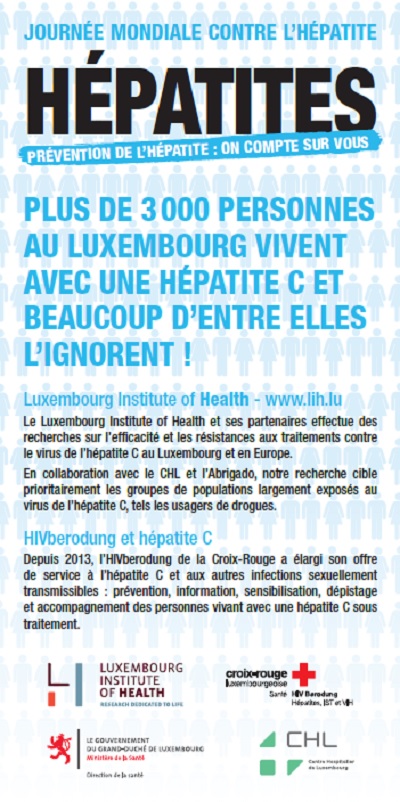
More than three thousand people in Luxembourg are living with Hepatitis C with many of them unaware.
Tuesday 28 July 2015, is the World Day against hepatitis, which will see the HIVberodung of the Luxembourg Red Cross, the Luxembourg Institute of Health, the Centre Hospitalier de Luxembourg and the Ministry of Health collaborate together in the fight against hepatitis.
Hepatitis B or C: besides the fact that these infections are often silent and evolve very slowly, the consequences can be extremely serious for one's health. Scientific experts at the Institute of Health (LIH), together with their partners, conduct research to better understand and control the disease. On Tuesday, between 08:00 and 10:00 at Luxembourg-Gare, and between 11:00 and 13:00 at the Place de la Resistance in Esch-sur-Alzette, the above organisations will be present to raise awareness about hepatitis, including screening and vaccination, as well as offering quick tests for hepatitis C screening in the mobile intervention unit for the promotion of sexual health (DIMPS).
Hepatitis: why a global day?
28 July is World Day against hepatitis, coordinated by the "World Hepatitis Alliance" in the fight against hepatitis. Hepatitis is characterised by inflammation of the liver, usually caused by infection with virus (A, B, C), but sometimes caused by abuse of alcohol or drugs. Often asymptomatic, hepatitis can cause liver destruction requiring a transplant. Hepatitis is considered chronic if it is present for more than 6 months. A vaccine exists for hepatitis A and B. No vaccine exists against hepatitis C, which is considered the most insidious hepatitis and most dangerous.
Viral hepatitis in Luxembourg
In Luxembourg, the prevalence of infections with the hepatitis C virus (HCV) is estimated at 0.5 - 1.0% of the population, meaning that between 2,250 and 4,500 people are infected in the country. The Department of Infection and Immunity of the LIH, in close collaboration with the National Service of Infectious Diseases and Gastroenterologists at different hospitals in the country, are following patients infected with hepatitis C. HIVberodung, meanwhile, educates, informs on prevention, screening features and provides psycho-social support to patients with hepatitis C treatment.
Towards a national plan against hepatitis
The Ministry of Health is developing a national plan of action against viral hepatitis, which aims to reduce the number of infections, increase the number of early diagnoses and improve the care and quality of life of patients. This plan includes improved surveillance and epidemiological knowledge of infection by creating a national registry.
How to prevent hepatitis?
Today, everyone can be vaccinated against hepatitis B and be protected against this dangerous disease that is widespread in many countries. Blood banks are participating in particular by undertaking analysis of blood samples.Infections can be transmitted within the family. Patients with hepatitis B have a special responsibility vis-à-vis their children, partners and relatives who must be vaccinated / protected against this infection. Children should also be vaccinated at birth against HBV as should travelers outside Europe, who have a greater risk than others and must ensure control of their vaccinations.
In Luxembourg, a vaccine against hepatitis B is available for all newborns. No vaccination is obigatory, but vaccinations are offered routinely during routine pediatric consultations as part of maternal and child health programmes. Vaccination rates are very high (93.6% of children vaccinated, accordign to a survey in 2012); Also, hepatitis B should no longer pose a major public health problem in the future. However, for hepatitis C, there is no vaccine. It mostly affects users of intravenous drugs who exchange their used equipment, and the homosexual population.
Given the often asymptomatic nature of hepatitis B and C, only a screening test can detect their presence. The screening test for hepatitis C can also be done for free and anonymously at DIMPS (www.dimps.lu).
Hepatitis B and C also include sexually transmitted infections; therefore, before going on holiday, the Ministry of Health organises an annual summer campaign of prevention of sexually transmitted infections. The purpose of this campaign is to remind people of the rules of safer sex including the consistent use of condoms during casual sex. The importance of early detection is also recalled, as more infection is discovered early, the faster the transmission to other sexual partners can be avoided. A dedicated website (www.safersex.lu) provides information on the main sexually transmitted diseases, their symptoms, treatments and prevention methods.
For further information, see www.sante.lu.