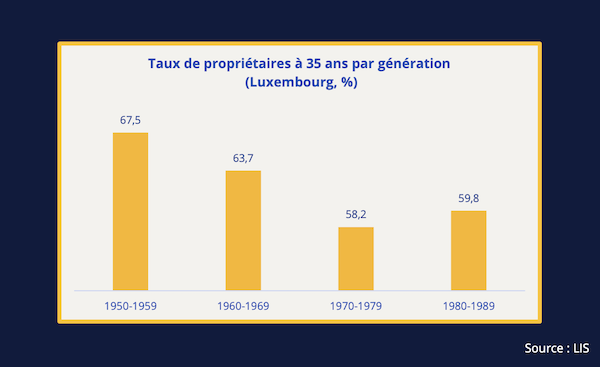
 Homeownership rate at age 35 by generation in Luxembourg (%);
Credit: LIS
Homeownership rate at age 35 by generation in Luxembourg (%);
Credit: LIS
On Thursday 10 September 2026, Fondation IDEA asbl published Working Paper No. 37, “Widening the Overton Window: Six Actions to Move Housing Policy Beyond Its Usual Responses”, by senior economist Michel-Edouard Ruben, examining possible new approaches to Luxembourg’s housing policy.
According to the report, proposals aimed at “reviving the property market” and “resolving the housing crisis” generally focus on three main approaches: supporting the purchasing power of owner-occupiers and rental investors through tax expenditure, simplifying procedures to increase housing supply and reforming property taxation to discourage speculation and encourage owners to bring land and existing housing onto the market. The analysis argues that these approaches should be complemented by additional measures.
The six proposed actions are to increase effective demand, make relations between landlords and tenants more flexible and secure, produce housing without consuming additional land, promote new forms of ownership, establish agreements with municipalities and remove obstacles to employers providing housing to their employees.
Under the first proposal, IDEA suggests creating a mutual fund for the production of housing intended for employees. As an illustration, a 0.5% housing contribution based on professional income could provide the fund with close to €200 million per year.
The paper also proposes making greater use of the existing housing stock, noting that nearly 70% of people aged over 65 live in under-occupied housing. Suggested measures include facilitating the division of large homes and encouraging the creation of additional housing units within existing properties.
Another proposal concerns new forms of home ownership. The analysis notes a structural decline in homeownership among younger generations and estimates that fewer than 20% of tenants are financially able to buy the home they currently rent. It suggests experimenting with progressive or shared ownership models already used in several European countries.
According to figures cited from LIS, the homeownership rate at age 35 stood at 67.5% for those born between 1950 and 1959, compared with 59.8% for those born between 1980 and 1989.
The full analysis is available on IDEA’s website.