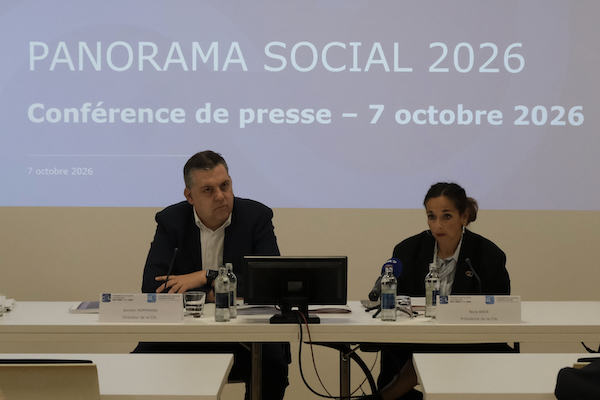
 (L-R) Sylvain Hoffman, Director of the CSL; Nora Back, President of the CSL;
Credit: Steven Miller, Chronicle.lu
(L-R) Sylvain Hoffman, Director of the CSL; Nora Back, President of the CSL;
Credit: Steven Miller, Chronicle.lu
On Wednesday 7 October 2026, the Luxembourg Chamber of Employees (CSL) held a press conference for the launch of the 2026 edition of its “Panorama social” (“Social Overview”) publication.
The CSL publication compiles key indicators regarding inequality, poverty, working conditions, employment, and unemployment, tracking their evolution over time and providing a socio-economic portrait of the country, while also incorporating a European perspective. For the 2026 edition, the report covers three main sections: Inequalities faced by the poor, Unemployment and employment, and Employment conditions and quality.
The press conference was led by Nora Back, President of the CSL, who began by stressing the importance of the publication’s findings and thanked those involved in the authoring of the report.
Nathalie Georges, Economic Advisor (Advice and Studies) at the CSL, then spoke regarding the report’s first section, which focuses on income inequality, the effect of housing costs and shortages, budgetary difficulties and how food aid reveals the true level of poverty in Luxembourg.
Nathalie Georges said: “We see in the context of the benefit of Panorama Social that despite a high level of life and a rather high level of prosperity, the advantages of this prosperity do not benefit everyone equally… The question is not so much that of wealth and the level of wealth, but it is much more important if we position ourselves in relation to the way in which this wealth is distributed to all members of society.”
According to the report, 14.8% of the population are at risk of poverty in Luxembourg (based on the risk of poverty compared to the income of the households), 22.4% of the households declare having difficulties in making ends meet (a reference to the living conditions of the households compared to the expenses they have to pay) and €6 million euros were paid in 2025 as non-refundable aids (paid for by the different social offices in the country).
The report details that families with children have relatively lower incomes; children and young people are the most vulnerable to poverty, with single-parent and larger families facing a concentration of risks; housing consumes an excessive share of income; and an observable rise in the levels of food aid distribution and homelessness reveal other aspects of poverty across the country.
“We can see that 22.2% of under-eighteen are at risk of poverty and 26% of young people from eighteen to 24 is the highest proportion of the distribution. Young people are strongly affected so that means that one-in-five children are affected by poverty or more than one-in-five children and more than one-in-four young people aged eighteen to 24 are at risk of poverty in Luxembourg. This is a number that really raises questions about what can be done with this young population,” highlighted Nathalie Georges.
Félix Martins De Brito, Economist, Management Advisor at CSL, spoke on the second and third sections of the report “Unemployment and employment” and “Employment conditions and quality”, which focus on the distribution of the unemployed by status and education level, the levels of young people not in employment or the education system, the circumstances of the “working poor” and employment conditions.
According to the report, in 2025 Luxembourg recorded one of its highest levels of unemployment in more than ten years (6.5%). This was only exceeded on two occasions: during the Covid19 pandemic in 2020 (6.8%) and 2015 (6.7%). Figures provided by ADEM for the report show that since the pandemic the number of unemployed people, who are graduates of higher education or post-secondary education, has been increasing.
Félix Martins De Brito noted: “In the past, the diploma may have allowed a longer to stay in employment but not necessarily better employment. Now we see [a diploma] is no longer as protective as it used to be.”
Additionally, the report highlights that in Luxembourg, across all poverty risk thresholds, the risk rate is high for those in full and part-time employment but lower than the Eurozone average for the self-employed.
“What we see is that if we look at the self-employed in Luxembourg, in terms of poverty, it is lower, regardless of their income. We are doing relatively well at this level. But if we look at the rate of poverty for salaried workers, we are still clearly above the standard observed in neighbouring countries. We are still among the countries that have the highest rate of poverty for salaried workers,” said Félix Martins De Brito.
The full report is available shortly at the CSL Website.