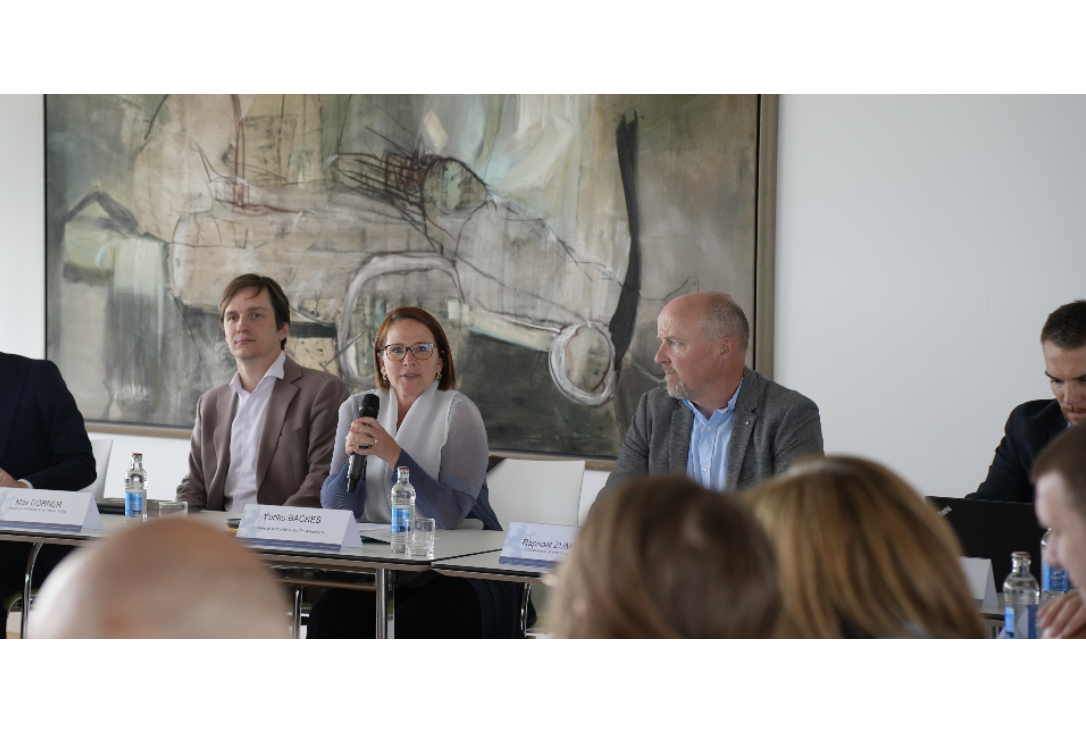
 (L-R) Max Dörner, General Coordinator, Luxembourg's Ministry of Mobility and Public Works; Yuriko Backes, Luxembourg's Minister for Mobility and Public Works; Raphaël Zumsteeg and Pierre Gierenz, Luxembourg's Ministry of Mobility and Public Works;
Credit: MMTP
(L-R) Max Dörner, General Coordinator, Luxembourg's Ministry of Mobility and Public Works; Yuriko Backes, Luxembourg's Minister for Mobility and Public Works; Raphaël Zumsteeg and Pierre Gierenz, Luxembourg's Ministry of Mobility and Public Works;
Credit: MMTP
On Tuesday 21 July 2026, Luxembourg's Ministry of Mobility and Public Works published the latest public transport security statistics, reporting a 5.8% increase in recorded incidents in 2025 and a further 7.9% rise during the first half of 2026.
The figures were presented during a meeting of the steering committee on public transport security, chaired by Luxembourg's Minister for Mobility and Public Works, Yuriko Backes. The meeting brought together representatives of the Public Transport Administration (ATP), CFL, the City of Luxembourg (VdL), TICE, Syvicol, trade unions, the Grand Ducal Police and Luxtram.
According to the ministry, the meeting provided an opportunity to review the 2025 security statistics, examine trends in reported incidents across the public transport network and take stock of the measures introduced in recent years. Participants also reviewed the progress of several projects aimed at strengthening safety, security and respect within public transport.
"Safety and respect in public transport are a shared responsibility and a permanent political priority. In the face of steadily increasing passenger numbers, we are continuing to invest, implement preventive measures and make the necessary adjustments to ensure a safe, calm and welcoming environment for everyone," said Minister Backes. She added: "In close cooperation with all our partners, our commitment is clear: to strengthen the protection of both passengers and staff, develop the tools available to them and promote a culture of respect and tolerance that must remain at the heart of every journey."
Growing passenger numbers
The continued growth of public transport has been accompanied by steadily increasing passenger numbers across all modes of transport. Luxembourg railway station now records nearly 80,000 daily passengers, while rail passenger numbers have increased from 22.5 million in 2015 to 31.4 million in 2025, representing almost nine million additional passengers over the past decade. Tram usage has also grown steadily, rising from 6.1 million passengers in 2019 to 35.2 million in 2025. At the same time, the RGTR network now operates more than 2.6 million services each year across the country.
The ministry noted that all partners reaffirmed the importance of a coordinated approach to ensuring safe and pleasant journeys.
Incident reporting
According to the ministry, the committee reviewed the 2025 security statistics, compiled on the basis of incident reports submitted by the various public transport operators. The findings show an increase in the number of recorded incidents. However, the ministry noted that this trend should be analysed in light of the continued strengthening of the reporting culture among public transport operators.
After 3,271 incidents were recorded in 2024, the figure rose to 3,461 in 2025, representing an increase of 5.8%. This trend has also continued during the first half of 2026: 1,884 incidents were reported between January and June, compared with 1,746 during the same period in 2025, an increase of 7.9%. Stakeholders in the sector noted that the systematic reporting of incidents makes it possible to better understand observed trends, identify risk situations and implement appropriate preventive measures.
The committee also noted an encouraging development regarding assaults against staff, which fell by 1.16% in the first half of 2026 compared with the same period in 2025. Data from the CFL Group on workplace accidents linked to assaults also showed an improvement. Per one million passengers carried, the rate of workplace accidents classified as "assault" stood at 0.19 in 2025, compared with an average of 0.52 during the 2014-2024 period. The ministry said this decrease illustrates the effectiveness of the prevention, awareness-raising and protection measures implemented in the context of continuously growing public transport use.
Secure driver cabins
According to the ministry, the steering committee also reviewed progress on the programme to equip buses with secure driver cabins designed to improve the protection of drivers.
As of Wednesday 15 July 2026, 824 buses operating on the RGTR network were equipped with secure driver cabins, representing 48.1% of the entire fleet. The rollout of this measure is continuing at a sustained pace, with 78 additional vehicles equipped over the past six months and around 150 buses over the past twelve months. The ministry said this steady progress reflects ongoing efforts to strengthen driver protection and improve safety conditions in the day-to-day operation of the network. The modernisation is also reflected in daily operations: 60% of monthly services are now operated by vehicles fitted with secure driver cabins, representing nearly six out of every ten journeys.
At CFL, 68 of its 83 buses, representing 82% of the fleet, are equipped with secure driver cabins. The remaining fifteen vehicles, which belong to an older generation, will be withdrawn from service by 2028, bringing the proportion of equipped vehicles to 100%.
Tram security measures
The committee also reviewed the measures implemented by Luxtram to strengthen safety and prevention across its network. Following the launch of a pilot phase in August 2025, which introduced security officers on board trams and along the line to support drivers in enforcing transport regulations, Luxtram strengthened the scheme from Wednesday 1 July 2026 by deploying a second team after positive results from the trial phase. According to the ministry, the security officers carry out prevention, patrol and assistance duties, while drivers remain responsible for operating the service and providing information to passengers.
Draft public transport law
The committee also discussed progress on Bill No. 8335 concerning safety, security, public order and video surveillance in public transport. The bill pursues three main objectives: establishing a legal framework dedicated to safety and public order in public transport; regulating the use of video surveillance and clearly defining its purposes; and introducing a system of administrative and criminal sanctions adapted to the offences identified.
Following supplementary opinions issued by the Council of State in December 2025 and May 2026, new amendments were presented to the parliamentary committee in June 2026. With regard to the system of administrative sanctions provided for in the bill, discussions within the committee highlighted members of parliament's request to strengthen the deterrent effect of the measures. As the fines currently provided for in the schedule of sanctions were considered too low to effectively prevent certain behaviour contrary to the rules applicable to public transport, an increase in the administrative fines is currently being prepared. On Friday 17 July 2026, the Council of State issued its third opinion, confirming that it is possible to collect and retain evidence obtained through video surveillance for submission to the competent courts in the event of legal proceedings.
Respect campaign
Committee members also reviewed the national campaign "Respect is as simple as saying hello!". On the occasion of the National Day of Respect in Public Transport, held on 3 May 2026, the campaign focused on respecting the sound environment in shared spaces. Its aim was to encourage behaviour that promotes passengers' comfort and well-being. An information and awareness stand also brought together public mobility stakeholders on Place de Paris in Luxembourg City on 4 May 2026.
Staff training
As part of the National Action Plan for Equality, CFL continues to implement internal initiatives to promote inclusion, diversity and equal opportunities in the workplace. To this end, it carries out training and awareness-raising activities for staff, notably through workshops organised during its Safety Days, which have brought together more than 5,000 participants since 2024 (1,630 in 2024, 1,725 in 2025 and 1,733 in 2026).
Body Cameras under review
The ministry also presented its analysis of initiatives under way in several European countries concerning the use of body-worn cameras (body cameras) by public transport staff. Initial findings highlight their potential for conflict prevention, de-escalating tense situations and protecting staff. According to the ministry, body cameras are an innovation whose potential merits further examination.
The ministry is also monitoring the gradual rollout of body cameras within the Grand Ducal Police. It noted that lessons learned from this experience will help assess the suitability and possible arrangements for introducing such a system while respecting operational requirements and data protection rules. At this stage, no decision has been taken on their possible deployment in public transport.
The steering committee concluded that all partners remain committed to continuously improving safety, security and service quality across Luxembourg's public transport network.