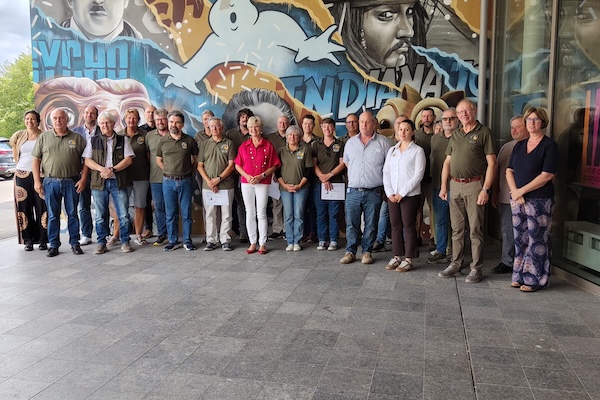
 Group photo;
Credit: Anna Silenchuk, Chronicle.lu
Group photo;
Credit: Anna Silenchuk, Chronicle.lu
On Wednesday 22 July 2026, non-profit association Sauvons Bambi Luxembourg presented its latest achievements, future ambitions and new digital platform during a conference held at Cinéma Kinoler in Kehlen.
Founded in 2020, the association uses drones equipped with thermal cameras to locate and rescue young deer hidden in fields before mowing begins. The project is carried out in collaboration with Luxembourg's Ministry of Agriculture, the National Centre for Continuing Professional Training (CNFPC), which hosts the Luxembourg Drone Centre, municipalities, farmers, hunters and a network of trained volunteers.
During the presentation, Sauvons Bambi showcased the results of its 2026 rescue campaign, during which volunteers saved 351 fawns, surveyed 4,961 hectares across Luxembourg, carried out 329 missions and certified fourteen new drone pilots.
Opening the event, Sonja Fischer, alderman of the Municipality of Garnich, welcomed attendees before handing over to Patrick Fantini, President of Sauvons Bambi Luxembourg, who reflected on how the initiative began after being inspired by similar projects in Switzerland and Belgium.
"The issue of safeguarding fawns during the harvest period was becoming increasingly important and we wanted to do something about it in Luxembourg," he said.
He described how the association had evolved from a small volunteer initiative purchasing its own equipment into a recognised organisation supported by “thousands of followers” and “numerous partners”.
Following the introduction, Patrick Fantini explained that the organisation's work is built around four essential pillars:
-
a structured approach, which combines proven methodologies, flight techniques and digital tools, including reusable flight plans, safety procedures and pilot certification to ensure efficient and secure rescue operations;
-
strategic partnerships;
-
volunteers, consisting of both certified drone pilots and field assistants responsible for safely retrieving and relocating animals found during flights;
-
beneficiaries, which now include more than 300 farmers, hunters and other land users across more than half of Luxembourg's municipalities. Although formal cooperation agreements currently exist with seventeen municipalities, the organisation stressed that it responds to requests throughout the country free of charge.
Explaining how the results are calculated, he noted that the association only counts animals as "saved" when they have successfully been reunited with their mothers.
Looking ahead, he said the association plans to further develop its digital tools, strengthen cooperation with the CNFPC, explore the use of artificial intelligence (AI) to assist wildlife detection and recruit additional volunteers to expand its intervention capacity.
Christof Struck, representing the Luxembourg Drone Centre at the CNFPC, outlined the centre's mission to develop professional drone training in Luxembourg. He explained that the partnership with Sauvons Bambi combines official drone certification with practical field training, allowing future pilots to gain the operational skills required for wildlife rescue missions.
The Luxembourg Drone Centre currently provides practical training for the A1/A3 and A2 drone categories, complementing the theoretical certification delivered by the Civil Aviation Directorate (DAC).
In their closing remarks, Claude Schroeder, Mayor of Garnich, Christof Goedert, President of the Federation of Luxembourg Hunting Associations (FSHCL), and Christian Reiter, Director of the DAC, reiterated that the initiative's continued success depends on strong cooperation between municipalities, farmers, hunters, volunteers and aviation organisations, alongside the recruitment of more drone pilots and volunteers.
The presentation also introduced “BambiMap”, a web-based platform designed to streamline the planning and coordination of rescue missions. Closing the conference, Luxembourg's Minister of Agriculture, Martine Hansen, welcomed the platform, saying it would further improve coordination between farmers, drone pilots and volunteers.
The conference concluded with the presentation of diplomas to the newly certified drone pilots.
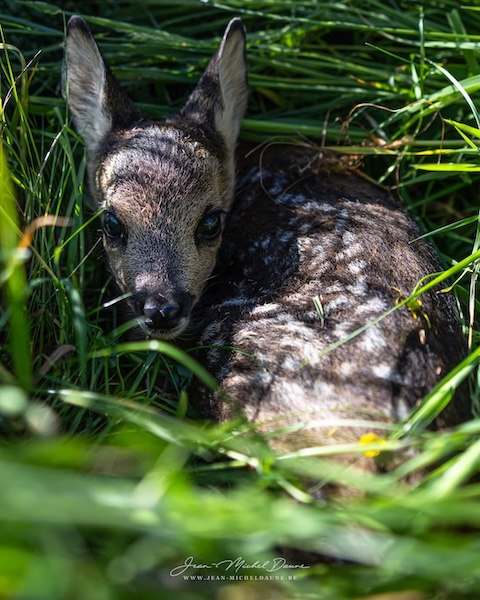
Photo credit: Jean-Michel Daune;
Photo caption: rescued fawn.