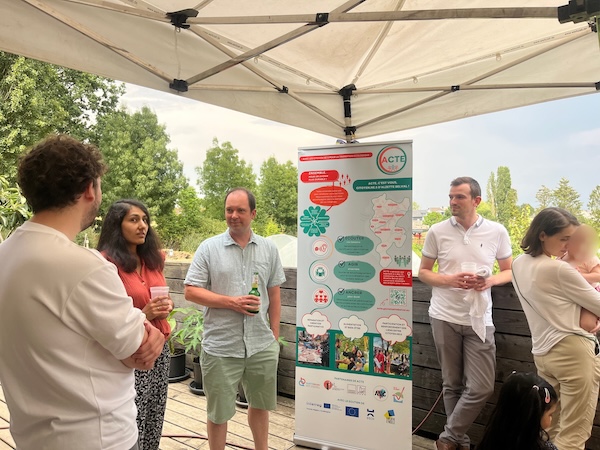
 Credit: ACTE
On Tuesday 21 July 2026, the “Family Near Zero-Waste Challenge" Alzette Belval edition concluded with a closing event at the Matgesfeld community garden in Sanem, following six months of workshops, practical activities and community exchanges.
Organised as part of the cross-border ACTE (Alzette Belval with Citizens for the Ecological Transition) project, the initiative brought together 26 families from Luxembourg and France to reduce the amount of household waste they produce by adopting more sustainable everyday habits.
The challenge began in January 2026 with a conference led by Jérémie Pichon, founder of the “Family (Almost) Zero Waste” movement. Over the following six months, participants attended workshops on topics including making solid shampoo, preserving food to reduce food waste, gardening and visiting the SIVEC reuse centre in Schifflange.
According to the organisers, among the participating families, most came from the Luxembourg municipalities of Sanem and Schifflange. Although several were already producing less waste than the regional average before the challenge began, seven in ten families further reduced their waste during the programme.
One family from Schifflange, consisting of two parents and three young children, reduced its glass and organic waste by 50%, said the organisers.
"Since taking part in the challenge, we pay much more attention to what we consume. We plan our shopping more carefully and think before buying," the father explained, acknowledging, however, that some waste remains difficult to avoid, particularly household rubbish and paper waste linked to children's nappies and gift packaging.
The organisers noted that participants described the practical workshops as one of the highlights of the programme. "The solid shampoo workshop was great – we'll definitely make it again at home," one participant said.
The visit to the SIVEC reuse centre also received positive feedback. "It was very interesting to discover the recycling centre. The challenge was very well organised and we enjoyed meeting other families to exchange ideas and discuss the difficulties we encountered. We'd definitely do it again," another participant commented, according to the organisers.
Many families agreed that reducing plastic packaging remains one of the greatest challenges. "Everything for children is over-packaged," said Débora, a participant from Belvaux.
She added that reducing waste requires careful planning, particularly when preparing shopping trips, while some products remain difficult to find without packaging.
Catherine, from Soleuvre, shared a similar view, suggesting that more weekly local markets with convenient opening hours would make waste reduction easier. "Completely avoiding waste is impossible in today's society, but small everyday actions can really make a difference – using reusable bags for bread and vegetables, buying products in bulk and reusing items," she said.
Organisers said the challenge helped create a strong sense of community among participating families, with the exchange of experiences demonstrating that the ecological transition is built collectively through gradual everyday changes.
Eight families received prizes in recognition of their efforts, while the overall winning family was recognised both for its waste reduction results and its active participation throughout the challenge. All participating families also received a “Near Zero-Waste Family” diploma printed on seed paper.
The challenge was organised by the European Grouping of Territorial Cooperation (EGTC) Alzette Belval and the Municipality of Sanem as part of the European Interreg ACTE project, which supports citizen-led initiatives promoting environmental sustainability, solidarity and community engagement across the Alzette Belval region.