
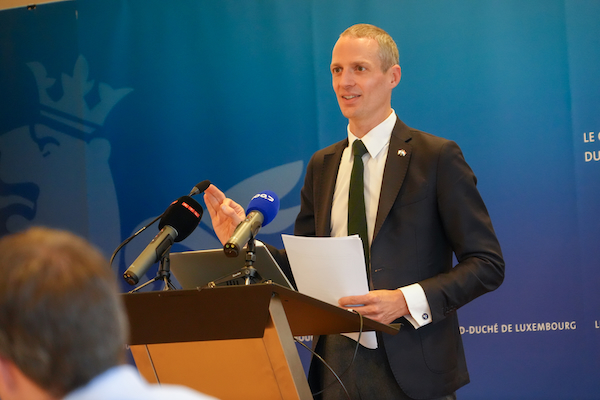
 Serge Wilmes, Luxembourg Minister of the Environment, Climate and Biodiversity;
Credit: MECB
On Wednesday 11 November 2026, Luxembourg’s Ministry of the Environment, Climate and Biodiversity announced changes to the “Klimabonus Mobilitéit” (“Climate Bonus for Mobility”) schemes.
According to the ministry, following the adoption by the Chamber of Deputies of the draft law on the financial aid scheme for the purchase of zero-emission road vehicles, as well as the draft law on the financial aid scheme for installations enabling the charging of electric vehicles, Luxembourg’s Minister of the Environment, Climate and Biodiversity, Serge Wilmes, presented the main changes to the “Klimabonus Mobilitéit” schemes.
The ministry said the extension of both schemes until 2030 represents an important milestone in the transition towards more sustainable mobility and directly contributes to the implementation of the National Integrated Energy and Climate Plan (PNEC).
To make electric mobility even more accessible, a pre-financing system for grants will also be introduced for new vehicles from 1 January 2027, following a model similar to the one already in place for photovoltaic installations.
Continued support for zero-emission vehicles
The previous financial aid scheme has been extended by four years, until 30 June 2030. It will apply to vehicles purchased or leased between 1 July 2026 and 30 June 2030.
For 100% electric vehicles ordered from 1 July 2026, grants will be tiered according to their energy consumption.
A grant of €6,000 will be awarded to:
- Electric cars with energy consumption not exceeding 160 Wh/km (16 kWh/100 km)
- Electric cars with seven or more seats, where the applicant is part of a household consisting of at least five people
- Electric vans
- Hydrogen fuel-cell cars
A grant of €3,000 will be awarded to:
- Electric cars with electricity consumption between 161 Wh/km and 180 Wh/km
- Electric cars with consumption of up to 200 Wh/km, provided that the maximum net power of the propulsion system does not exceed 150 kW
The €1,500 grant for the purchase of a second-hand car at least three years old is being maintained.
Grants for electric quadricycles, motorcycles and mopeds will remain at 50% of the purchase price excluding VAT, up to a maximum of €1,000.
Grants for bicycles and electrically assisted pedal cycles will remain restricted to households receiving the cost-of-living allowance or the energy bonus at the time of purchase. They cover 50% of the purchase price excluding VAT, up to a maximum of €600.
The grant for cargo bikes is also being maintained at 50% of the purchase price excluding VAT, up to a maximum of €1,000.
A new pre-financing system from 2027
To simplify the process for citizens, a pre-financing system will be introduced for new vehicles purchased from 1 January 2027.
Dealerships participating in this system will be required to deduct the grant amount from the final invoice issued to the customer.
They will subsequently be reimbursed by the State once they have submitted their application.
Dealerships wishing to participate in this system will have to register with a register maintained by the Environment Agency.
This system will operate alongside the traditional grant application procedure. Beneficiaries will be able to choose either option, with the grant amount remaining the same in both cases.
Increased grants for charging points
The grant scheme for private charging infrastructure is also being extended until 2030 and will receive targeted enhancements, particularly in support of residential buildings.
Particular attention is being given to multi-unit residential buildings to facilitate the roll-out of electric vehicle charging facilities in apartment blocks. Property owners and co-owners' associations will be eligible for increased grants towards the installation of collective smart charging management systems, as well as the necessary preparatory works.
The financial assistance will be structured as follows:
- €750 for a standard charging point (maximum 50% of the cost excluding VAT)
- €1,200 for a smart charging point (maximum 50% of the cost excluding VAT)
- €1,400 for a bidirectional charging point (maximum 50% of the cost excluding VAT until 1 January 2027)
- Up to €40,000 for multi-unit residential buildings, to co-finance the purchase and installation of a collective smart charging management system, as well as the necessary adaptation and equipment works (maximum 50% of the cost excluding VAT)
This scheme will apply to investments for which invoices are issued between 1 January 2026 and 31 December 2030.
By extending the “Klimabonus Mobilitéit” grants and introducing pre-financing, the Government said it is strengthening its support for individuals, families and co-owners' associations wishing to invest in clean mobility solutions, and these measures will help accelerate the electrification of Luxembourg's vehicle fleet, expand charging infrastructure and achieve a lasting reduction in greenhouse gas emissions.
“By extending and increasing the ‘Klimabonus Mobilitéit’ grants until 2030, we are providing citizens with long-term certainty and tangible incentives to embrace electric mobility. These measures represent an important lever for achieving our climate targets while making the transition easier for households and co-owners’ associations”, said Minister Wilmes.