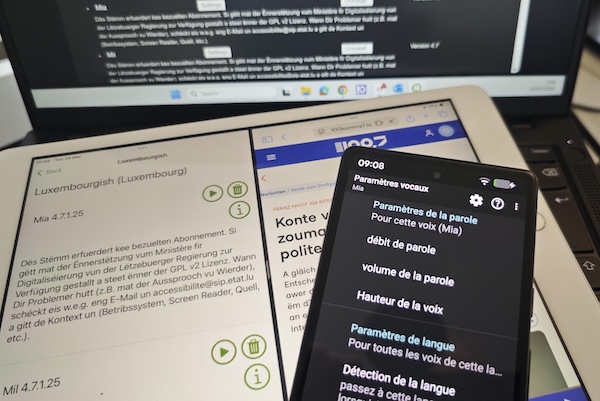
 Credit: Dominique Nauroy
On Monday 8 June 2026, Luxembourg’s Ministry for Digitalisation and the Centre for the Development of Visual Skills announced the launch of a free application capable of reading on-screen text in the Luxembourgish language.
According to the ministry, the project marks a significant milestone in promoting and improving the accessibility of the Luxembourgish language, and the application is available now, free of charge on Windows, macOS, Android and iOS. It features two voices, one female and one male, capable of reading on-screen text in the Luxembourgish language.
Available Free of Charge
The project has produced two voices named “Mil” and “Mia”, which are available free of charge for Windows, Apple and Android devices. Their source code has also been published as open-source software and may be freely reused.
These voices integrate with screen readers, the tools used by blind and visually impaired people to interact with computers, telephones and tablets. More specifically, they work with VoiceOver in Apple environments, TalkBack on Android, and NVDA or JAWS on Windows.
Independently of these solutions, the voices can also read aloud a text or selected text on macOS or Windows.
Technology for everyone
The ministry highlighted that the project is intended in particular for blind and visually impaired people, but also for anyone who wishes to benefit from spoken rendering of texts displayed in Luxembourgish on the screen of a computer or mobile device.
A collaborative effort
The project was funded by the Ministry for Digitalisation as part of the Tech-in-gov initiative. It was led by the Government Information and Press Service in partnership with the Zenter fir d'Lëtzebuerger Sprooch (ZLS) and the Centre for the Development of Visual Skills (CDV). Implementation was entrusted to the company LouderPages, a specialist in this field.
The ministry detailed that the collaborative effort made it possible to benefit from resources provided by the ZLS, which were essential to the project, as well as from its linguistic expertise. It also incorporated feedback from CDV users in order to refine and improve the solution.
Further information about the project, as well as guides designed to facilitate a quick start, can be found at https://accessibilite.public.lu/en/news/2026-03-30-screenreaderLB.html.