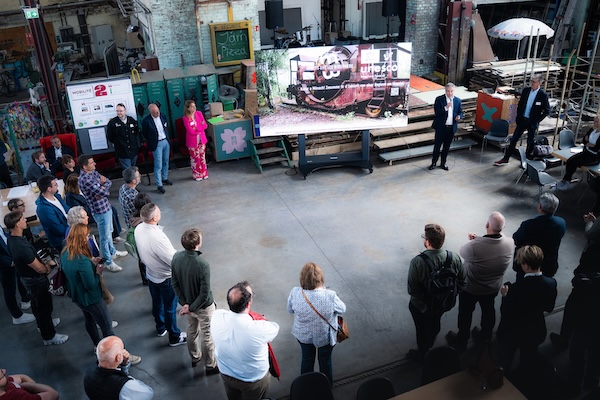
 Credit: Alex Benavente
On Monday 8 June 2026, the Intercommunal Union PRO-SUD organised a Regional Forum for the shared and sustainable development of the Minett region at Hall VeWa in Dudelange.
The event brought together representatives of municipalities, institutions, regional partners, local stakeholders and civil society to discuss the priorities that will guide the sustainable development of southern Luxembourg in the coming years.
According to Luxembourg's Ministry of Housing and Spatial Planning and PRO-SUD, the forum was organised as part of the preparation of the new territorial cooperation agreement between the two parties. It was based on the results of a representative Ilres survey conducted among 837 residents of the eleven municipalities of the Minett region, as well as on projects already carried out by PRO-SUD and the Minett Unesco Biosphere.
Discussions confirmed the importance of a coordinated regional approach to challenges that extend beyond municipal boundaries, including quality of life, social cohesion, ecological transition, mobility, housing, sustainable resource management, territorial attractiveness and citizen participation.
Participants worked in groups on six key themes corresponding to the main areas of activity of PRO-SUD through the Minett Unesco Biosphere. These thematic sessions were chaired by regional elected representatives who are members of the PRO-SUD committee, ensuring a direct link between participants' contributions and the priorities promoted by the municipalities of southern Luxembourg.
Throughout the forum, Christian Weis, President of PRO-SUD, and Claude Meisch, Luxembourg's Minister of Housing and Spatial Planning, took part in discussions with stakeholders. Their participation highlighted the importance of direct dialogue between municipalities, regional actors and the state in shaping future territorial priorities.
"The Regional Forum confirmed the willingness of municipalities, institutions and regional stakeholders to work together on the future of the Minett region. The contributions collected provide an important basis for defining the priorities of the 2027-2031 work programme of PRO-SUD and the Minett Unesco Biosphere," said Christian Weis.
According to the ministry and PRO-SUD, discussions focused in particular on climate resilience, the development of more sustainable and better-connected mobility, biodiversity protection, adapting cities to climate change, promoting the Minett region's natural and industrial heritage, and strengthening short supply chains and local products.
"Behind the major challenges of housing, mobility and climate change lies, above all, the daily lives of residents. The discussions held during this Regional Forum confirmed the importance of listening to those who experience the territory every day and of building, together with them, solutions adapted to tomorrow's challenges. Our responsibility is now to translate these reflections into concrete actions. The future territorial cooperation agreement with PRO-SUD will allow us to accelerate this momentum and develop projects that respond to residents' needs while sustainably preparing the future of our territory," said Minister Meisch.
The forum forms part of the objectives of Luxembourg's national spatial planning master programme and the principles of UNESCO's "Man and the Biosphere" programme. Since 2020, PRO-SUD has managed the Minett Unesco Biosphere, which positions southern Luxembourg as a territory for experimenting with ways to reconcile environmental protection, urban development, economic activity, citizen participation and quality of life.
The contributions collected during the forum will be analysed by PRO-SUD in the coming weeks and will contribute to the preparation of the 2027-2031 multiannual work programme of PRO-SUD and the Minett Unesco Biosphere, which will be annexed to the new territorial cooperation agreement.
Through this initiative, PRO-SUD aims to strengthen its role as a platform for regional cooperation and contribute to making the Minett region more resilient, attractive, inclusive and sustainable.