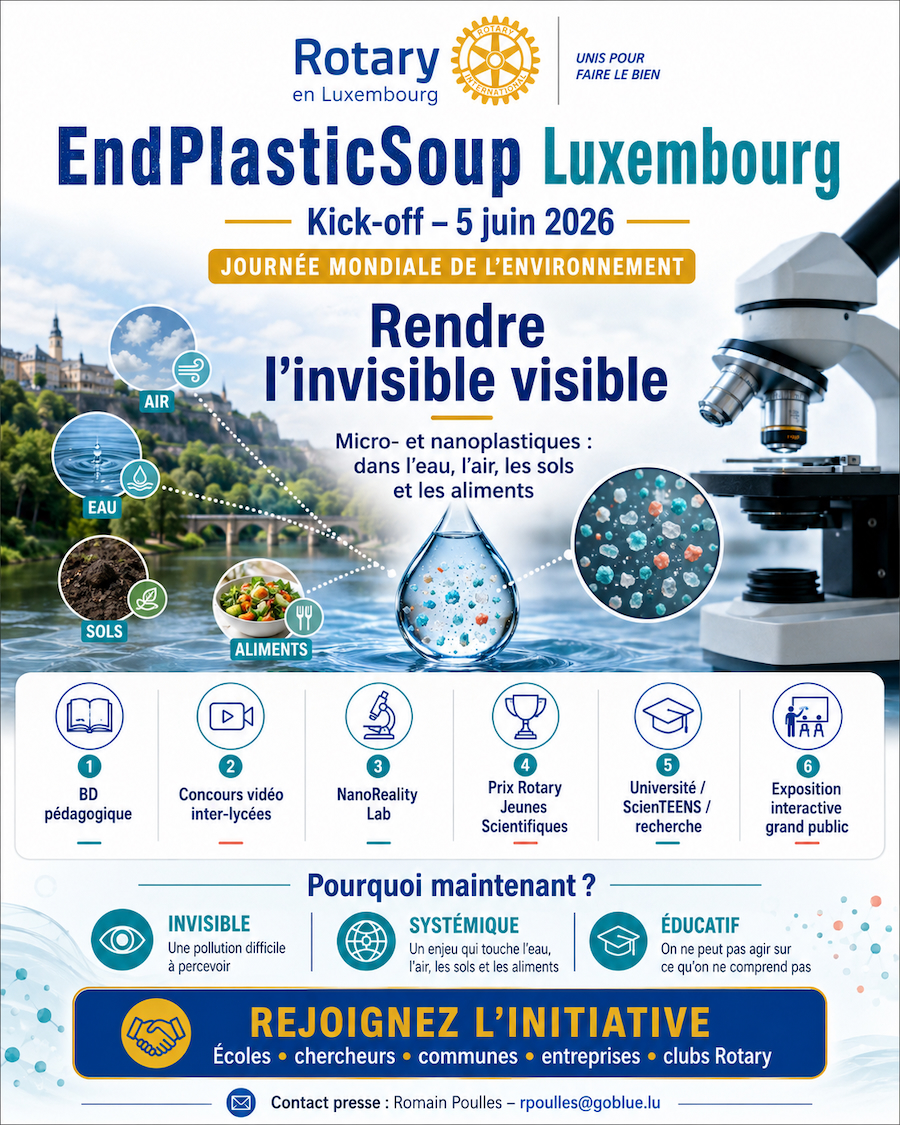
Ahead of World Environment Day on Friday 5 June 2026, the Rotary clubs of Luxembourg, under the impetus of the Rotary Club Luxembourg-Horizon, announced they are launching an educational and scientific initiative on microplastics and nanoplastics.
Rotary Club Luxembourg-Horizon highlighted that tyre use in Luxembourg could release more than two quintillion rubber microparticles, or two million kg into the environment each year.
Under the impetus of the Rotary Club Luxembourg-Horizon, the Rotary clubs of Luxembourg are launching an educational and scientific initiative on microplastics and nanoplastics. As part of the “EndPlasticSoup” project, the Luxembourg initiative forms part of a long-term approach: to raise awareness, educate, understand and take action. It is aimed primarily at younger generations, schools, secondary schools, students, researchers, public institutions, businesses and civil society.
The Rotary Club Luxembourg-Horizon said: “Visible plastic pollution is now widely recognised. However, a substantial part of the problem is far more difficult to perceive: plastics break down into increasingly smaller particles, eventually becoming microplastics and nanoplastics. These particles may be present in water, air, soil and food and are receiving increasing scientific attention regarding their potential effects on ecosystems and on human and animal health. The message from EndPlasticSoup Luxembourg is simple: Plastic does not disappear. It becomes smaller. Our ambition is to make the invisible visible.”
The project is based on several complementary pillars:
• an inter-school video competition;
• a “NanoReality Lab”, a mobile educational mini-laboratory;
• a Rotary Young Scientists Award dedicated to microplastics and nanoplastics;
• collaboration with the University of Luxembourg and ScienTEENS;
• an interactive exhibition for the general public, notably through the Science Centre;
• and, at a later stage, an educational comic book for children.
These initiatives stem from the work of the Rotary Sustainability Commission, which identified microplastics and nanoplastics as a key topic for educational and scientific action in Luxembourg. The framework documents provide for a gradual rollout from 2026 to 2028, with particular attention paid to young people aged five to 30, scientific partnerships and factual, solution-oriented and non-alarmist communication.
EndPlasticSoup Luxembourg also wishes to build partnerships with the country’s scientific and educational stakeholders, including the University of Luxembourg, LIST, LIH, FNR, the Science Centre, the Luxembourg Young Scientists Foundation, schools, secondary schools and relevant industrial stakeholders. The objective is not to assign blame, but to create a constructive coalition capable of better understanding the sources, impacts and solutions.
Romain Poulles, Rotary Club Luxembourg-Horizon stressed: “Plastic does not disappear: it fragments. What was once visible becomes invisible, but not harmless. With EndPlasticSoup Luxembourg, we want to make this subject understandable, scientific and engaging, particularly for younger generations.”
Rotary Luxembourg noted that it builds on strong international experience. Through EndPolioNow, the Rotary association has demonstrated its ability to mobilise long-term support around a global public health issue. The ambition of EndPlasticSoup Luxembourg is to apply the same approach of mobilisation, education and partnership to an emerging environmental and public health challenge.
EndPlasticSoup Luxembourg invites schools, researchers, municipalities, businesses, institutions and Rotary clubs to join this initiative in order to build a Luxembourg programme that is visible, rigorous and replicable. Parties can register their interest to Rotary Club Luxembourg-Horizon via email: rpoulles@goblue.lu