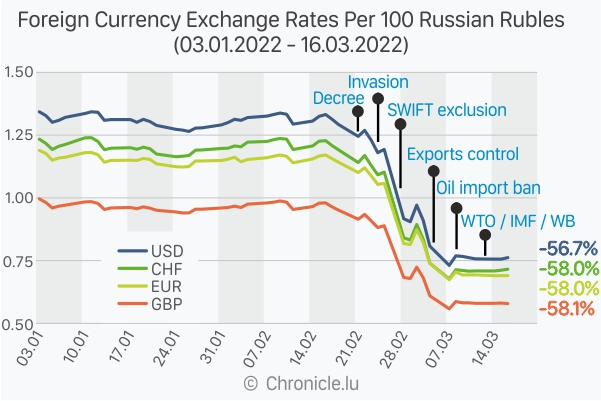
Economic sanctions and trade bans against Russia by the United States (US), the United Kingdom (UK), the European Union (EU), Canada, Japan, Switzerland, South Korea, Australia and several other countries have caused the Russian ruble to lose at least 50% of its face value since the beginning of 2022 against major world currencies, foreign exchange data has shown.
The following are some of the key events which have played an instrumental role in downgrading the of Russian ruble.
On 21 February 2022, the day after the Winter Olympics ended in Beijing, China, Russian President Vladimir Putin signed decrees recognising the independence and sovereignty of Ukraine's separatist regions of Luhansk and Donetsk as the Luhansk People’s Republic (LNR) and the Donetsk People’s Republic (DNR), respectively. This move was widely denounced, with the US administration issuing an executive order the same day, restricting investment, import or exports of goods to the LNR and DNR regions. The EU imposed similar sanctions on 23 February 2022.
On 22 February 2022, Germany suspended the certification of Nord Stream 2, a newly completed gas pipeline from Russia to Germany bypassing Ukraine, putting the $11 billion project under uncertainty.
In the early hours of 24 February 2022, Russian troops crossed into Ukraine and officially launched a military invasion. Russia called the invasion a "special military operation" to "denazify" the country.
On 26 February 2022, the US, the EU, the UK and Canada announced a joint action to exclude several Russian banks from the international SWIFT financial messaging system, severely limiting Russia's access to its foreign currency reserves and representing a major blow to the Russian banking sector. On 2 March 2022, the EU confirmed that seven Russian banks would be cut off from the SWIFT system, effective from 12 March 2022. That same day, Russia’s largest bank, Serbank, stopped almost all of its European operations due to liquidity shortages.
On 27 February 2022, President Vladimir Putin put Russia's nuclear deterrent on high alert, further escalating the Ukraine conflict into a possible nuclear fallout.
On 28 February 2022, Russia’s central bank more than doubled its key interest rate, from 9.5% to 20%, suspended the sale of foreign currencies and imposed a $10,000 limit on foreign cash withdrawals, which briefly supported the ruble.
On 8 March 2022, the US announced a ban on Russian oil, liquefied natural gas and coal imports and the UK announced the phasing out of Russian oil imports throughout 2022.
On 11 march 2022, the US, the EU, the UK, Canada and Japan proposed new measures against Russia, including increasing import tariffs by revoking Russia's "most favoured nation" (MFN) status at World Trade Organization (WTO) and denying borrowing privileges at the World Bank and the International Monetary Fund (IMF).
The series of economic and individual sanctions, as well as trade bans against Russia, led the ruble to depreciate by 57% to 58% against UK's pound sterling, the Euro, US dollar and the Swiss franc compared to 3 January 2022.
Multinational companies and conglomerates also voluntarily suspended or decreased their businesses in Russia, further adding pressure to the ruble.
Global banks like Goldman Sachs, all Big Four accounting firms and payment services like Visa, Mastercard, PayPal and American Express announced the suspension of their services.
Oil giants Shell, BP and Exxon announced the suspension or reduction in oil and gas trade with Russia, denting the petroleum exports-dependent revenue for the Russian economy.
The US also announced technological export controls against Russia, such as on semiconductors, computers, telecommunications, information security equipment, lasers and sensors, limiting the long-term sustainability of Russian military capabilities.
The simultaneous economic sanctions have effectively cut off Russia from global financial markets and made inaccessible its $640 billion of gold and foreign exchange reserves, triggering an economic crisis for Russia which analysts have estimated will lead to inflation of up to 20%, as well as 5% to 8% of economic contraction in 2022.