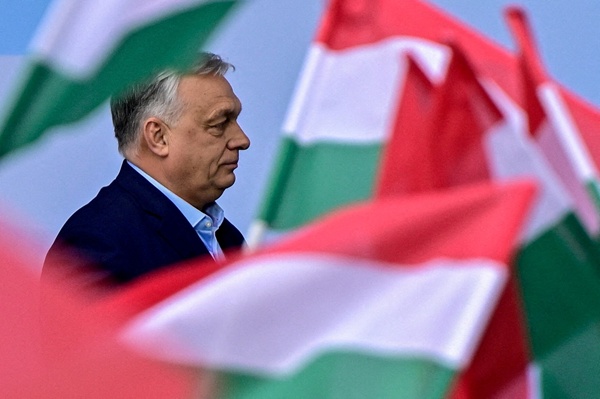
 Hungarian Prime Minister Viktor Orban attends the first so-called "Patriots' Grand Assembly" of nationalist groups from Europe, in Budapest, Hungary, 23 March 2026;
Credit: Reuters/Marton Monus/File Photo
Hungarian Prime Minister Viktor Orban attends the first so-called "Patriots' Grand Assembly" of nationalist groups from Europe, in Budapest, Hungary, 23 March 2026;
Credit: Reuters/Marton Monus/File Photo
BRUSSELS/BUDAPEST (Reuters) - Few EU leaders will miss Hungary's Prime Minister Viktor Orban if he loses an election on Sunday 12 April 2026 after he blocked key policies, including vital aid to Ukraine, but they do not expect his rival - if elected - to fully reverse Budapest's approach to Europe.
Most opinion polls suggest Orban's nationalist Fidesz party, in power since 2010, could lose to Peter Magyar's centre-right Tisza party.
Orban, who maintains friendly ties with Russian President Vladimir Putin and is also a close ally of US President Donald Trump, has often infuriated his EU partners, most recently by blocking a vital €90 billion loan to Ukraine.
"This was the last straw that broke the camel's back," said one EU diplomat. "On our side, the hope to talk reason into Orban is gone."
If Orban loses power, diplomats from multiple EU governments say they hope for an end to Hungary's blockade of policies ranging from the Ukraine loan to sanctions against Russia and violent Israeli settlers.
If Orban wins and continues to wield his veto, some officials expect a push to sideline Hungary.
"It seems that 'more of the same' is no longer an option for most EU countries," former Latvian Prime Minister Krisjanis Karins, who spent years around the table with Orban at EU summits, told Reuters.
"If Orban stays, we will have to change how we work," added a senior European official.
A Hungarian government spokesperson did not respond to a request for comment.
"Everybody hopes Orban will lose"
Reuters spoke with over a dozen current and former officials familiar with Europe's relationship with Hungary on the implications for the EU of next month's election. Speaking on condition of anonymity to discuss internal politics in a member state, many were blunt about their frustration with Orban.
"I think everybody hopes Orban will lose," said a second EU diplomat.
European officials have long fretted over what they see as the erosion of democratic norms in Hungary as Orban consolidated executive power, curbed media freedoms and NGO activities, and ran campaigns disparaging the EU and its policies.
Orban denies accusations of eroding democracy, casting himself as a defender of Europe's traditional Christian values against an out-of-touch liberal elite.
But the Orban government's close ties with the Kremlin even after Russia’s full-scale invasion of Ukraine in 2022 led to a deeper rupture between Budapest and many Western capitals.
German Chancellor Friedrich Merz said last week that Orban's veto of the Ukraine loan was an act of "gross disloyalty" that damaged the EU's reputation and ability to act.
No "revolution" if opposition wins
While many in Brussels hope for a new era in relations with Budapest in the event of a Tisza win, there is also caution.
Vera Jourova, a former deputy head of the European Commission, told Reuters an opposition victory would "renew the chance of unity on basic security matters" in the 27-nation EU.
But Magyar - who is remembered in Brussels as a sharp negotiator when he served as a Hungarian diplomat - would still be among the most sceptical voices on migration and the possibility of Ukraine joining the EU, officials say.
"I have very few illusions about Magyar's world view. We should be careful not to expect too much," said a third EU diplomat. "The difference will be more in tone of voice than substance."
A fourth EU diplomat added: "Magyar is from the same political family [as Orban], nobody is expecting a revolution."
Magyar has said he wants to firmly anchor Hungary in the EU and NATO, and he is particularly keen to unlock most of the approximately €17 billion of EU funds earmarked for Hungary that Brussels froze over Orban's refusal to comply with rule-of-law standards.
Richard Demeny, an analyst at Budapest-based think tank Political Capital, said: "I don't expect 180 degrees change [from a Magyar-led government] regarding EU relations, but we can expect a more constructive relationship with Brussels."
An adviser to Magyar, speaking on condition of anonymity, said it was true that such a government would not differ greatly from Orban's administration on migration and EU enlargement.
"But the difference," the adviser added, "is that Orban used this to blackmail [the EU] and represent the Russian interest. We will represent the Hungarian interest."