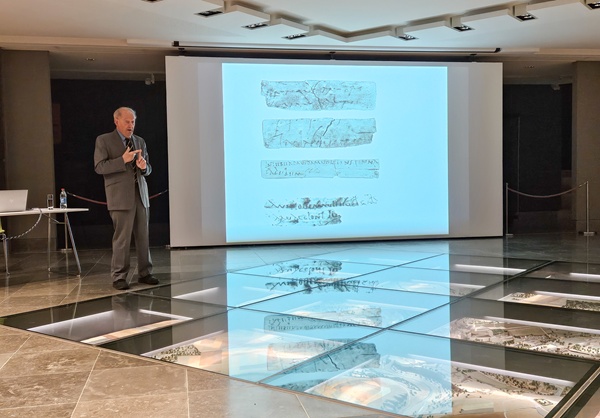
 Professor Alan Bowman;
Credit: Jazmin Campbell, Chronicle.lu
Professor Alan Bowman;
Credit: Jazmin Campbell, Chronicle.lu
On Wednesday 6 May 2026, the Musée Dräi Eechelen in Luxembourg-Kirchberg hosted a conference titled "Vindolanda - Voices from Rome's Northern Frontier".
Organised by Luxembourg's National Institute for Archaeological Research (INRA) in collaboration with the National Museum of Archaeology, History and Art (MNAHA), the Oxford University Society of Luxembourg, the University of Luxembourg and Archeolux, the free event brought together close to 80 attendees to hear Professor Alan Bowman (UK) speak about the historic Vindolanda tablets and their significance for understanding life on the Roman frontier.
Alan Bowman, Professor Emeritus of Ancient History and one of the leading scholars involved in deciphering the tablets, was introduced by Professor Andrea Binsfeld of the University of Luxembourg, who highlighted his distinguished academic career and his pioneering role in advancing the study of ancient documentary evidence through digital imaging technologies.
Discovered in 1973 at the Roman fort of Vindolanda near Hadrian's Wall in northern England, the tablets are among the oldest surviving handwritten documents from Roman Britain. Written in ink on thin wooden sheets, they offer unparalleled insight into daily life on Rome's northern frontier between approximately AD 85 and 120.
Speaking to Chronicle.lu before the conference, Professor Bowman explained that the tablets remain significant because "there's really no material like this ever found before", particularly in northern Britain.
He noted that their discovery in such large quantities at Vindolanda was "dramatically unusual" at the time. The tablets are exceptional because they present a substantial body of written material from a military unit in a part of the world where one would not have expected it, he said.
During his lecture, Professor Bowman explained how the tablets have transformed historians' understanding of Roman Britain by revealing not only military administration, but also trade, literacy and social life within frontier communities.
One of the most famous examples is a birthday invitation from Claudia Severa to Sulpicia Lepidina, widely regarded as the earliest known surviving handwritten text by a woman.
Professor Bowman said this type of document "illustrates the sophistication of social life in the farthest reaches of the empire."
He also highlighted a strong regional connection between Vindolanda and present-day Luxembourg and the surrounding area, noting that many of the soldiers mentioned in the tablets were recruited from the Rhine delta region, notably Batavia and Tungria. "There's a huge link there," he remarked, adding that most of the people documented came from areas geographically close to Luxembourg.
During his lecture, Professor Bowman traced the remarkable story of the tablets' discovery and explained the painstaking process of deciphering the fragile ink-written texts.
Speaking to Chronicle.lu, he recalled how his own involvement began partly by chance during a visit to Vindolanda in the mid-1970s, when archaeologists had just uncovered additional tablets and asked whether he could help read them. That unexpected encounter developed into 50 years of research.
"It was partly happenstance and partly the fact that I'd done my doctorate and subsequent research on deciphering largely Greek cursive documents from Egypt," he explained.
Professor Bowman described the steep learning curve involved in deciphering the cursive Latin handwriting, noting that early readings were sometimes significantly revised as scholars gained more contextual knowledge and as imaging technology improved.
"We got it totally wrong the first time," he said, referring to an early interpretation of one tablet later corrected through improved analysis.
He demonstrated how advances in infrared and multispectral imaging have dramatically enhanced researchers' ability to recover faded text, while also noting that some fragments remain undeciphered.
Among the examples discussed during the lecture were military strength reports, supply records and personal correspondence that reveal a surprisingly literate and administratively sophisticated frontier society.
Professor Bowman spoke of the "remarkable range of social status" represented in the correspondence, including letters involving slaves, while the documents also revealed the considerable mobility of soldiers across the Roman frontier.
One particularly memorable tablet included a request for beer supplies for soldiers - an anecdote that resonated with the lecture's discussion of links between the frontier community and the broader Rhine region, where brewing traditions were already well established.
Professor Bowman reiterated that the tablets reveal "a very literate and cultured community on the northern frontier".
He also emphasised how the tablets challenge traditional assumptions about literacy in the Roman world. During the Q&A session, he argued that literacy may have been more deeply embedded ("deepspread") across social strata than previously understood, even if literacy rates across the empire were likely relatively low overall ("not widespread").
In response to other audience questions, Professor Bowman also discussed emerging imaging technologies and the possibility that some still-undeciphered fragments may represent the earliest surviving examples of Latin shorthand.
The event offered local audiences a rare opportunity to hear from and engage directly with one of the foremost experts on the Vindolanda tablets and Roman frontier life.