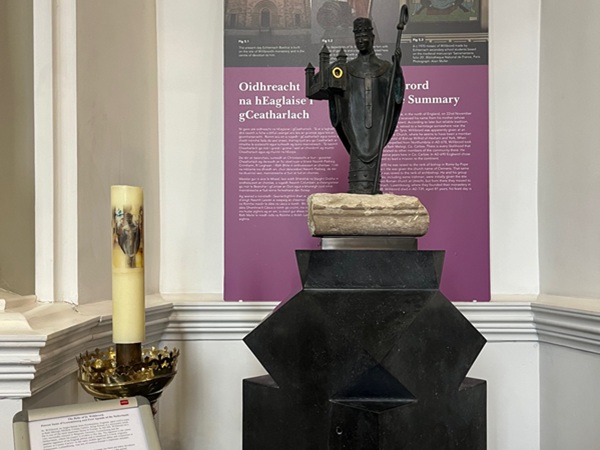
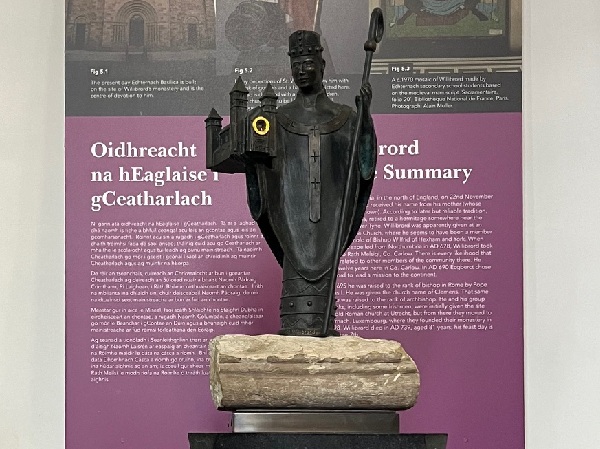
 St Willibrord statue in Carlow Cathedral;
Credit: Chronicle.lu
St Willibrord statue in Carlow Cathedral;
Credit: Chronicle.lu
While Cyprus currently holds the Presidency of the Council of the European Union for the first half of 2026, Ireland will assume the Presidency for the next six months from 1 July 2026.
Ireland has already started preparations and recently announced details of an initiative aimed at engaging communities across the country on Ireland’s European relationships during the six-month term, including strengthening each county’s cultural, business and community links with other parts of Europe.
During this period, Ambassadors of EU Member States in Ireland, accompanied by the Irish Ambassador in the relevant EU Member State capital, will be invited to visit counties across Ireland to undertake a programme of public engagements focused on Ireland’s European relations and its role in the European Union.
To plan for this, each of the 26 counties in the Republic of Ireland are being paired with one of the other 26 EU Member States.
Chronicle.lu understands that Government Minister Jennifer Murnane O'Connor, Member of the Irish Parliament for Carlow Kilkenny, lobbied for Carlow to be paired with Luxembourg based on the historical links going back 1,300 years when the Patron Saint of Luxembourg and First Apostle of the Netherlands, St Willibrord, was ordained in Carlow. Her work paid off and Carlow has been confirmed as being paired with Luxembourg.
St Willibrord's Origins
As many are aware, St Willibrord was born in Northumbria in England around AD 658, and died on 7 November AD 739 in Luxembourg where he had founded the Abbey of Echternach.
He was a Benedictine missionary who was first educated at Ripon Abbey in Yorkshire, England, and then left for Ireland where he spent twelve years studying to become a priest at the monastery of Rathmelsigi (in what is now Co Carlow), and was ordained in AD 688 in the nearby monastery of Old Leighlin, aged 30 years.
Why Ireland? Why Carlow? According to Dermot Mulligan, Curator of Carlow County Museum which has a permanent exhibition dedicated to St Willibrord, historians believe that an ecclesiastical meeting was being held in AD 630, the Synod of Magh Lene (also known as the Synod of Mag Léna or Old Leighlin), at which the process for calculating the date of Easter was being agreed.
Thus the region had developed a reputation for the training of monks in monasteries. Dermot Mulligan also explained that St Bede (672-735) wrote an edifying account of Willibrord's penance, devotion and charity, enabling others to know about Willibrord.
Another factor could well have been the Great Plague that first struck the south of Britain in AD 664, then spread northwards, encouraging emigration from Britain.
In AD 678, Willibrord travelled with St. Egbert and others to train there with the aim of then travelling on to Frisia (modern-day Netherlands/Belgium), undertaking missionary work. In AD 688, after completing their training, first St. Egbert went out, but returned after two years, unsuccessful; Willibrord then went out himself, in AD 690, leading a group of English and Irish men, initially to Utrecht and then to Luxembourg where he established a monastery and scriptorium.
On 21 November 695 he was consecrated as an Archbishop of the Frisians by Pope Sergius I in Rome, Italy. He became the first Bishop of Utrecht and, in 698, he founded the Benedictine Abbey in Echternach, on the site of a 1st-century Roman villa, including a scriptorium.
St Willibrord and Carlow County Museum
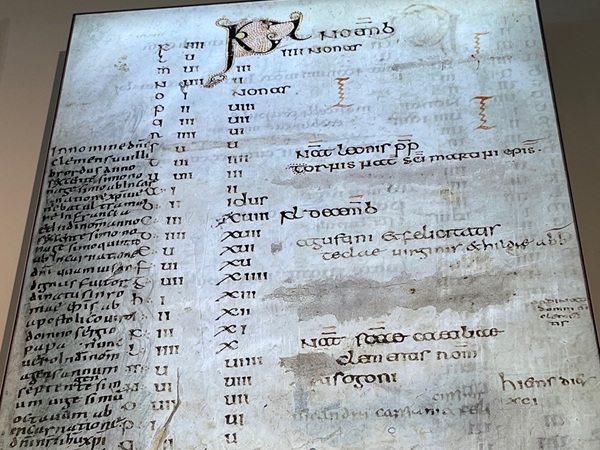
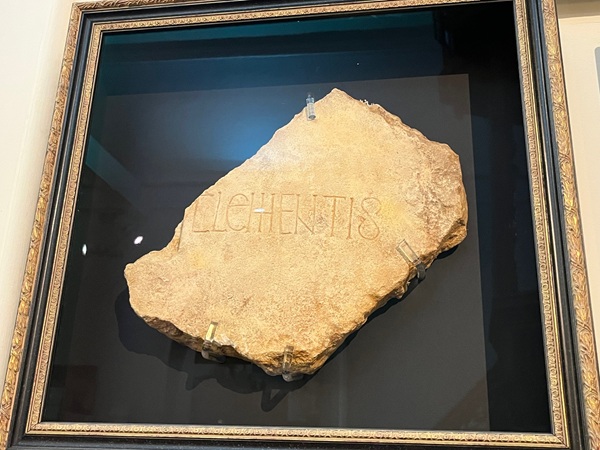
In Ireland, when Willibrord was ordained he took Clementis as his religious name: the Carlow County Museum has a copy of a stone tablet on display, with this name engraved. It also has an enlarged copy of a page from Willibrord's diary, the original being on display in Paris.
In 1804, Napoleon Bonaparte visited Luxembourg shortly after becoming Emperor. As the scriptorium in Echternach held many important documents, the monks were concerned for their safety and decided to send them out to various locations throughout Europe for safe keeping, with St Willibrord's diary ending up in Paris. This document shows the first know use of Anno Domini (AD) in the world, written in Luxembourg.
When travelling to Ireland, Egbert and Willibrord would have crossed the Irish Sea by boat to the mouth of the River Barrow and then travelled upstream to Rathmelsigi in the townland of Clonmelsh, around 10km from the present Carlow town (current population 27,000) which was only established as an Anglo-Norman borough in the early 13th century. The old tow-paths used by horses still remain and are currently being converted into walking paths along the entire length of the river.
The Carlow County Museum is located in the former two-storey Presentation Convent which also housed a primary school. Other displays include artifacts from the Carlow Sugar Factory, the gallows trap door from Carlow Gaol, and a 19th-century wooden pulpit from the next-door cathedral.
Carlow Cathedral
Less than 100m from the Carlow County Museum is Carlow Cathedral which opened in 1833.
It contains a bronze statue of St Willibrord which was installed in June 2017. It was a gift from Echternach, and was brought to the cathedral following a procession from St. Laserian's Cathedral, Old Leighlin, marking a permanent connection between the two locations.
It shows Willibrord as a young monk, holding a scale model of the Basilica of Echternach in his right hand, and a bishop's crozier in his left hand. Embedded in the rose window of the miniature basilica is a sacred replica, a (bone) relic from St Willibrord whose remains are located in Echternach.
The statue is mounted on a plinth made from Carlow limestone, with a layer of Echternach sandstone, taken from the remains of the original abbey, the crypt of the present-day Basilica.
Rathmelsigi Monastery
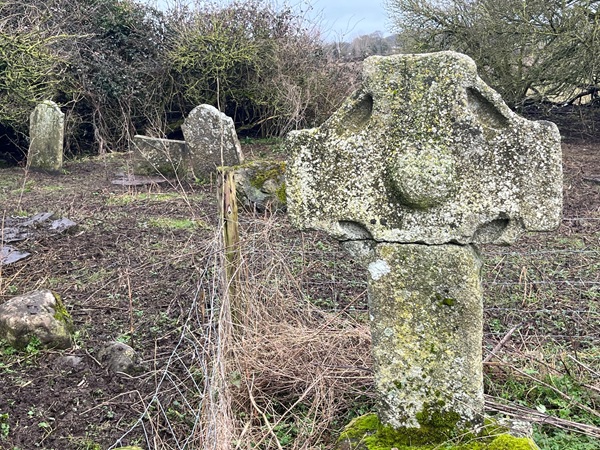
All that remains of the monastery is a stone cross which has been restored in 2019. In August that year, a delegation from Echternach, Luxembourg, visited for the unveiling of the restored early medieval cross and the signing of a Friendship Agreement between both town councils.
The granite cross, dating from Willibrord’s time, is not currently publicly accessible without permission from the landowner.
While the exact number of monks who were there is unclear, Rathmelsigi Monastery was closely associated with other major Irish monasteries of the era, such as the nearby one at St. Laserian's Cathedral in Old Leighlin, which is believed to have held over one thousand monks.
The Rathmelsigi monastery was used to train Anglo-Saxon monks: all the monastery buildings from that time would have been wooden, sealed with wattle and daub; as a result, no archaeological remains have survived.
Another local site that can be traced back to Willibrord’s time in Carlow is a holy well (St Laserian’s) which has public access.
Maintaining St Willibrord's Links with Carlow
In 2017, a delegation of almost 60 people travelled to Echternach to participate in the Hopping Procession on Whit Tuesday (the Tuesday after Pentecost), and smaller delegations have travelled at the same time of the year since, including in 2024 and again in 2025 when a business delegation also participated. Plans are afoot for another visit this May, with a large delegation possibly travelling in May 2027.
In July 2025, Ireland's Taoiseach (Prime Minister) Micheál Martin visited Luxembourg and met with Prime Minister Luc Frieden in Echternach at the shrine of St Willibrord.
Also, a book "Missionary, Saint, Political Actor: Willibrord Between Ireland, Britain and Merovingian Francia (690-739)" written by Dr Michel Summer, was presented in November 2024 in Echternach, in collaboration with the Willibrordus-Bauveräin Asbl and the Irish Embassy in Luxembourg.